
How the Mona Lisa Became the Most Disappointing Attraction in the World.
Part I: A Cautionary Tale for Overtourism

Back in 2019, the British people decided that the most disappointing attraction in the world was the Mona Lisa. So how is it that Da Vinci’s masterpiece, a painting Walter Isaacson described as ‘the greatest emotional painting ever done’ has become more disappointing than Mannekin Pis (more commonly known as ‘boy urinating in fountain’) and Checkpoint Charlie (which, let’s face it, is a crossroad in Berlin)?
Debunking the Myths
There are two arguments leveled at the Mona Lisa. The first is that the painting is smaller than expected. Given that Vermeer’s ‘Girl with Pearl Earring’ and Botticelli’s ‘Portrait of a Young Man’ are similarly sized (and people don’t complain about their size), I think we can rule out the dimensions of the Mona Lisa being the source of disappointment.
The second argument is that the Mona Lisa is ‘overrated’. This one is harder to dismiss, because defining and quantifying ‘expectation’ is famously difficult. With that said, it’s fair to assume that most visitors are not disappointed by Da Vinci’s technique, his use of sfumato or chiaroscuro. In fact, I don’t think it has anything to do with the painting, or with art whatsoever.
The Louvre has a Maths Problem
I think the cause of disappointment has more to do with economics. Or more precisely, the role economics has played in changing how we experience the Mona Lisa.
The Louvre is open for a total 9,560,000 seconds a year. Every year, about 9 million people visit the gallery and according to the museum, 4 in 5 of them are there to see the Mona Lisa. So all we have to is divide the time available by the demand to see the Mona Lisa and it gives each person 1.39 seconds to look at Mona Lisa.
Unless you are Beyoncé, you aren’t seeing the Mona Lisa on your own. And because giving each person 1.39 seconds is physically impossible, the Louvre are forced to move 100 people in and out of the Salle des Etats every 2 minutes, every day of the year. Which is why we experience the portrait like this:
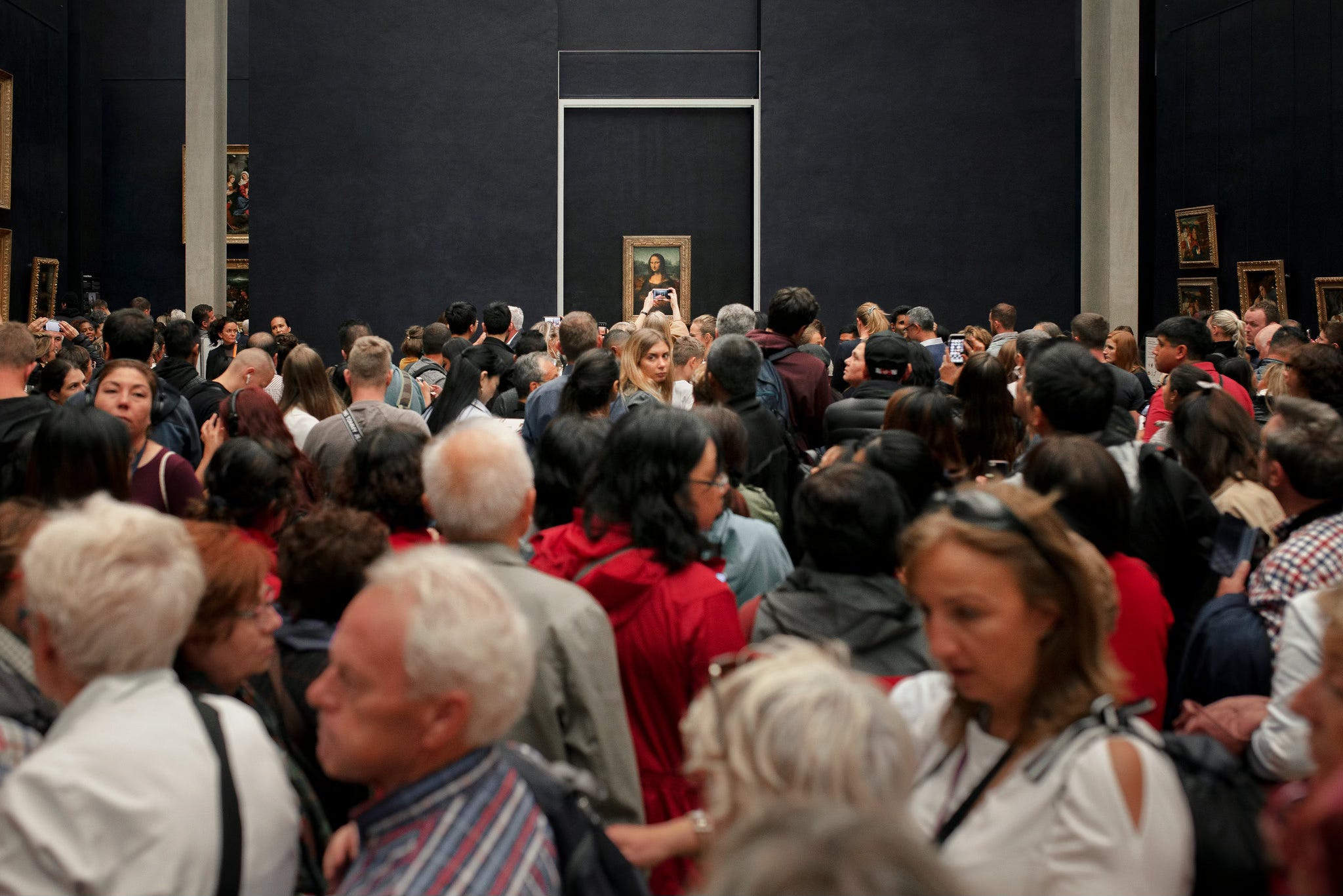
The painting isn’t the problem. The experience is. You queue for hours, often in sweltering heat, to get two minutes with ‘La Jaconde’, before being barked at to move along as the next 100 people shuffle in. It feels more like airport security than an art gallery.
The Breaking Point
Frustration at the experience has been getting worse for years. Reviews of the gallery are 20% lower in June and July 2024 when compared to the same period in 2017. According to a sentiment survey by Equator, most reviews cite queues, crowds, and a lack of time to appreciate the picture as the main reason for their one or two star rating.
And it isn’t just the visitor experience that is suffering. In 2019, staff walked out in protest of overcrowding and working conditions. Later that year, the New York Times suggested taking down the picture entirely. By January 2025, it had become so bad that the Director of the Gallery, Laurence des Cars, described it as being at ‘saturation point’.

‘La Nouvelle Rénaissance’ of the Louvre
On January 28, 2025, Emmanuel Macron, the President of France, announced that the gallery was set to undergo a major renovation. The Mona Lisa was set to get a dedicated exhibit, there would be a new entrance on the side of the Seine and new facilities added to once again establish the Louvre as the world’s greatest art gallery. So the question is, why does the Louvre think architecture and a structural overhaul is going to save the Mona Lisa?
This wasn’t the gallery’s first attempt to limit the impact of crowds. Back in 2023, the Louvre set a visitor cap of 30,000 per day. And just last year, in early 2024, they announced a price hike of 30% for entry, ahead of the Paris Olympics.
The problem is that neither of these proposals worked. The visitor cap, for example, wasn’t low enough to have any significant impact on queues (it increased viewing time by about 45 seconds). As for the price increase, it amounted to just €5 (US$5). Given that two in three people are visiting the gallery coming from abroad, the increase was never going to be an effective deterrent (it’s more likely that the price increase was just an opportunity to maximize revenue from ticket sales)
The Louvre’s Legacy Issues
To understand why the Louvre is turning to renovation, we need to go back to the last major overhaul of the gallery, imaginatively entitled ‘Le Grand Louvre’, almost 30 years ago. Led by renown architect IM Pei, this project was seen as an opportunity to expand exhibition space, boost museum capacity, and make a statement about France as a country that ‘respects traditions, yet embraces modernity’.
The major feature Pei added was the now-iconic glass pyramid at the centre of the gallery. This was to be the main entrance, into which a new subterranean level granted visitors access to all wings of the gallery. It also converted the government offices in the Richlieu wing into exhibition space, adding 22,000 sqm to the Louvre’s already extraordinary footprint.
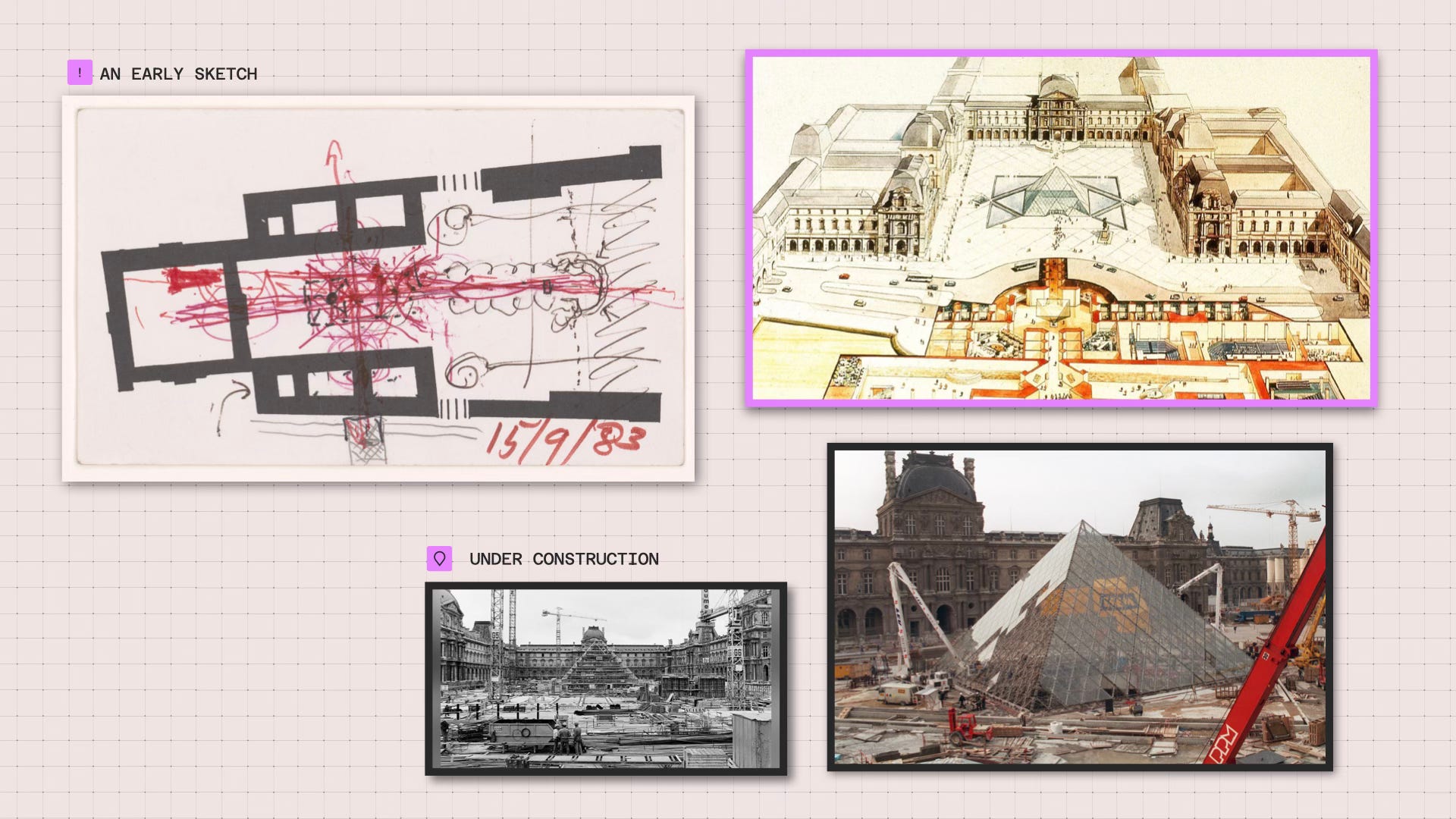
On the surface, it appeared that Pei’s work had fulfilled the brief. However, it wasn’t long after the renovation was complete, however, that the short-comings of the design became apparent. Wade Saunders, writing in Art in America, in 1993, notes:
“The ever increasing attendance seems to have been imperfectly anticipated. Regarded esthetically, most of Pei’s decisions appear inspired…but impractical. There can be a long wait to enter and some jostling to exit…these problems will get worse with attendance.”
Wade Saunders was right. The problems did get worse with attendance. By the mid 2000s, queues had become a frequent occurrence at the entrance of the gallery. The Mona Lisa had to be moved, twice, to accommodate the volume of visitors. And as complaints mounted, so did the negative attention the gallery was receiving.
We All Want to See the Same Things
Architecture wasn’t the only problem. The layout of the exhibits were also causing problems. In 2014, in a study of where people went and how long they stayed in the gallery, MIT found that most people wanted to see the same exhibits, along the same routes, at the same time.
A DATA VISUALIZATION OF VISITOR FLOW IN THE LOUVRE, USING THE MIT SENSELAB STUDY, EQUATOR
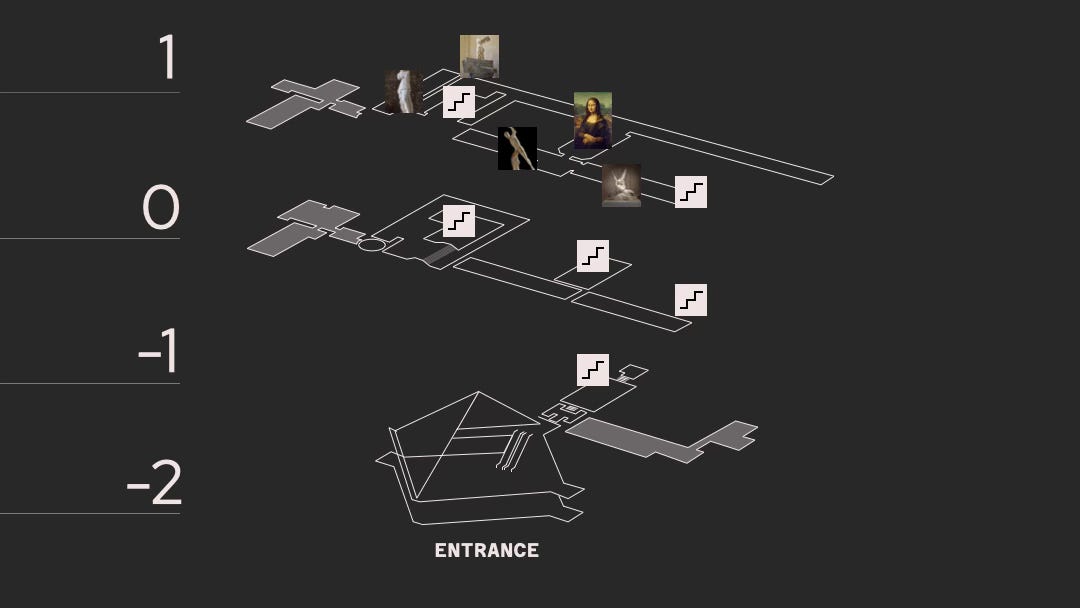
What is so extraordinary about MIT’s findings is the implication that visitor motivations have little bearing on behavior. Whether it’s fear of missing out (FOMO), an appreciation of artistic genius, or a tick on a bucket-list; we end up gravitating towards the same attractions.
By placing the Mona Lisa, the Wedding at Cana, St. John the Baptist, and the Winged Victory of Samothrace (among others) together in the Denon Wing, the Louvre had inadvertently created a gravitational force: the opportunity to see ‘most of the best works in just a couple of hours’.
As a result, Despite there being over 77,000 sqm of exhibit space, with over 35,000 exhibits on display, most tourists end up crowding around the same 20 works, in one small section of the gallery.
The Mona Lisa: a Cautionary Tale
It’s hard not to reference Icarus in the story of the Mona Lisa. The Louvre’s unchecked ambition, imperfect planning, and a reluctance to acknowledge the destructive force of overtourism have resulted in one of the greatest portraits ever made falling from grace. If Da Vinci and the Louvre aren’t immune from the impacts of overtourism, how confident are we that other galleries, attractions, destinations and travel brands will be?
It also shows how a ‘one-size-fits-all solutions’ to overtourism don’t work. Raising prices and limiting the number of tourists are default solutions for many in the travel industry, but they shouldn’t be. Art should be universal and democratic, open to as many people as possible. By limiting supply and increasing prices, we’d be transforming the gallery into a Birken Bag or a Rolex: something exclusive and only available to the rich.
For these reasons, I think the Louvre and its Director, Laurence des Cars, should be commended for this announcement. Renovation is a practical solution, one that addresses the fundamental problem of the gallery: that it was never designed to hold 9 million people.
The question now is, what does the Louvre have to do to make it work? We’ll answer that next week in Part II. Or, if you can’t wait, we’ve made a video about it all here.