
Think sustainability doesn't sell? Hold my beer.
What the travel industry can learn from the extraordinary rise of craft beer.

Before we begin, a quick note: The Travel Graph is now Outlier, a name that better reflects what we’re trying to do: look beyond the obvious data points and surface the deeper economic, behavioural, and structural shifts shaping travel.
We’re also introducing a paid tier. We’ll be publishing a monthly deep dive or guide for paid subscribers (starting with this one), while continuing to share regular free articles.
We’re building Outlier to become a go-to resource for independent travel brands and decision-makers planning their next product moves and strategies. You can subscribe for free or consider becoming a paid subscriber and get full access for $8/month or $80/year.
This makes it possible for us to invest the time and research required to create the resources that travel brands doing the most good need to outcompete those doing the most harm. Thank you for your support!
There is a long-held consensus among marketing executives that sustainability does not sell.
Despite 4 in 5 travellers claiming to want to travel more sustainability, few are willing to back that up with their wallets. Fewer than 5% of travelers pay for carbon offsets. Most will never inquire about a BCORP certification or read an annual impact report. According to Booking.com’s ‘2024 Sustainability Survey’, despite good intentions, sustainability simply isn’t a priority for most travellers when it comes time to book their trip. It’s what Harvard Business Review calls the ‘intention-action gap’ in sustainability: consumers want to feel virtuous, not be virtuous.
There’s just one problem with this theory.
At the end of my street is a liquor store filled with four human-sized fridges, filled with a bewildering array of craft beers, from East Coast IPAs, fruit sours, to coffee stouts. They have names like Rocky Ridge, Margaret River Brewing and Eagle Bay.
Most of these beers are locally sourced, create regional jobs, rural investment, and have limited distribution (which equates to fewer emissions). They are – by most measures – far more sustainable than the likes of corporate brewing. They also cost 3x as much as Heineken, Amstel, or Budweiser.
According to marketing executives, these brands shouldn’t exist. So what has craft beer figured out? And what does that mean for travel and tourism?
1. It’s what they didn’t say.
Craft beer has some fairly substantial sustainability credentials. When compared to corporate brewing, it produces fewer emissions in transportation and in packaging. It also plays a vital role in revitalising neighbourhoods, promoting local investment, creating local jobs, and acting as a space for community engagement. In Australia, two-thirds of brewing jobs are in rural communities. Because of this, it is attributed to supporting community engagement and fostering a sense of local pride and identity.
Not that you’d know any of this. Most microbreweries don’t brandish their sustainability credentials. They don’t make BCORP certification or lower emissions a premium feature that consumers have to pay more.
They don’t compete on everything. They found their genuine advantage - local identity, authenticity and independence. In doing so, craft beer tapped into the 4 in 5 consumers who were looking to support local businesses (KPMG) in a way that was meaningful to them. By evoking place, reconnecting beer drinkers to their communities, traditions, and local cultures, craft beer became an expression of self identity for consumers.
Proof of this is everywhere. Just look at craft beer brands Camden Town, Beavertown, Goose Island, Margaret River Brewing, Eagle Bay, Brooklyn Brewery, 4 Pines, Kyoto Brewing Company, Darling Brew… all of them are named after, or references to a place. In fact, a 2023 study of all 506 Czech microbreweries found that 65% chose their name to signal where they were from.
Craft beer identified the values that mattered to its markets, then built brands on just that.
2. Go big or go home.
These breweries weren’t shy about building bold brands centred on local identity. Nor were they afraid to take on the corporate giants. Craft went bold, bright and loud.
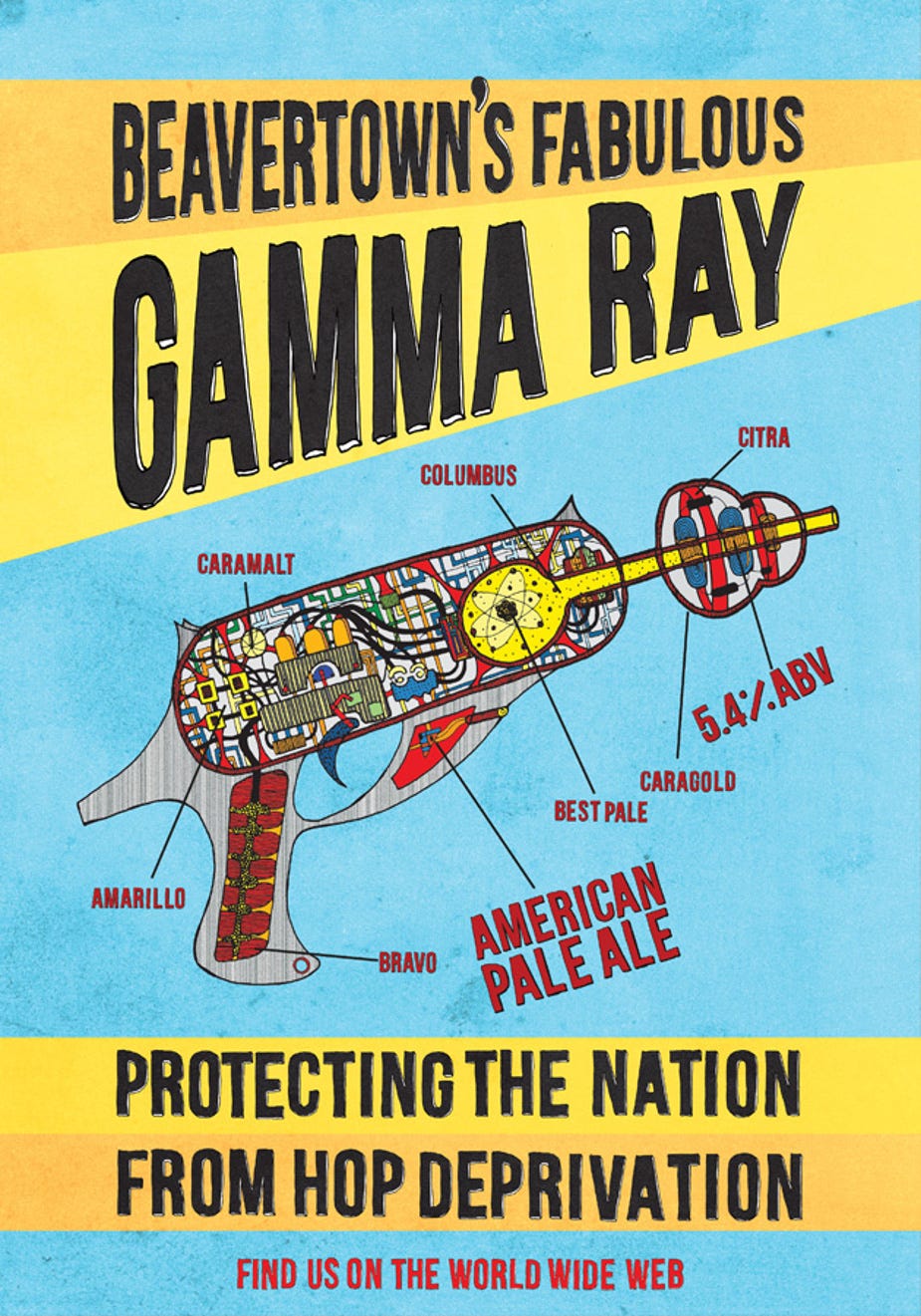
They knew what they were, who they were marketing to, and were more than happy to market themselves as different. Take UK-based Beavertown, for example. Named after the Cockney nickname for De Beauvoir Town, the area in Hackney where the brewery was founded in 2011, its original brand was inspired by graphic novels, and marketed deliberately as an alternative to traditional beers. It was loud. So much so, they built entire ad campaigns focused on “protecting the nation from hop deprivation”.
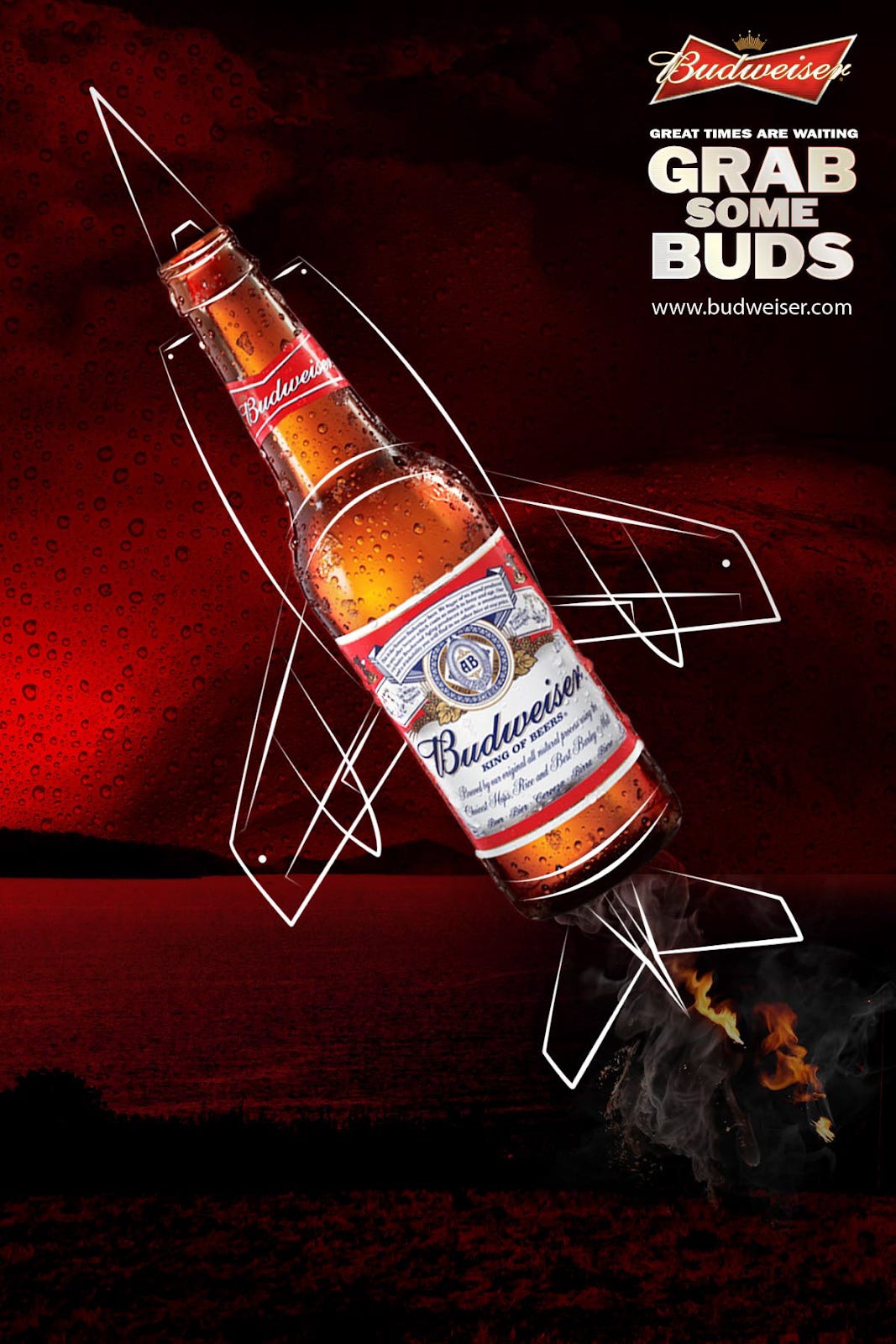
Budweiser, meanwhile, leant into … fighter jets?
3. They turned product into brand-reinforcing experiences
Craft breweries don’t sell beer that happens to be from somewhere. They sell somewhere that happens to make beer. Camden Town Brewery isn’t a brewery in Camden; it’s the experience of Camden in a glass.
This went beyond branding. Breweries quickly doubled up as brew pubs and restaurants, providing spaces for local communities to meet, for artisans to exhibit crafts, sell merchandise and foster a greater sense of local community identity. These experiences attracted visitors, generated economic activity and gave a reason to travel to places they’d otherwise never go.
Sound familiar?
The effect was that the impact storytelling was woven into the experience, not bolted on in a report no one is going to read. The idea that craft beer, micro-breweries, brew-pubs are all about local jobs, revitalisation, giving back to communities is visible on every visit, on every social media post, and reflected in the brand every time you see the packaging.
Sure, visitors came for great-tasting, high-quality beers. But what really set craft beer apart - and why they could charge up to 4x more – was that it offered an experience that tapped into consumer aspirations to connect with local identities and feel a sense of community. One that is woven into the very fabric of the product and brand identity.
The Proof.
The rise of craft beer has been staggering. In the US alone, microbreweries increased from 1,500 in 2000 to over 8,000 in 2023. The total number of craft breweries reached an all-time high of 9,683 in 2023, with a dollar value estimated to be $28.8 billion a year (significantly larger than the revenues of OpenAI). According to the Brewers Association, the craft brewing industry employs almost 200,000 full-time equivalent jobs each year. That’s equivalent to Apple, Netflix and Dropbox combined.
In Australia, that growth is even more significant. In 2000, there were less than 50 breweries in the country. Today, that number is closer to 650. Over half of the jobs in the industry are in micro-brewing, of which two-thirds are in rural communities.
The success of craft beer’s local identity strategy didn’t go unnoticed by the corporate giants like Ab InBev, Asahi and Heineken. In fact, as sales of craft beer soared, fears over market share and positioning among the corporate giants grew.
So they all quietly went on a spending spree. The first major acquisition was kicked off by Ab Inbev (ABI), who acquired Goose Island in 2011. It then bought LA’s largest craft brewer, Golden Road, in 2015. By 2023, ABI owned 19 craft brands. Heineken, not wanting to be left behind, acquired the once fiercely independent Lagunitas in 2017, as well as the aforementioned Beavertown in the UK. While down under, in Australia, Japanese giant Asahi acquired Mountain Goat, Pirate Life and Balter Brewing, while Kirin/Lion acquired Stone & Wood, and Little Creatures.
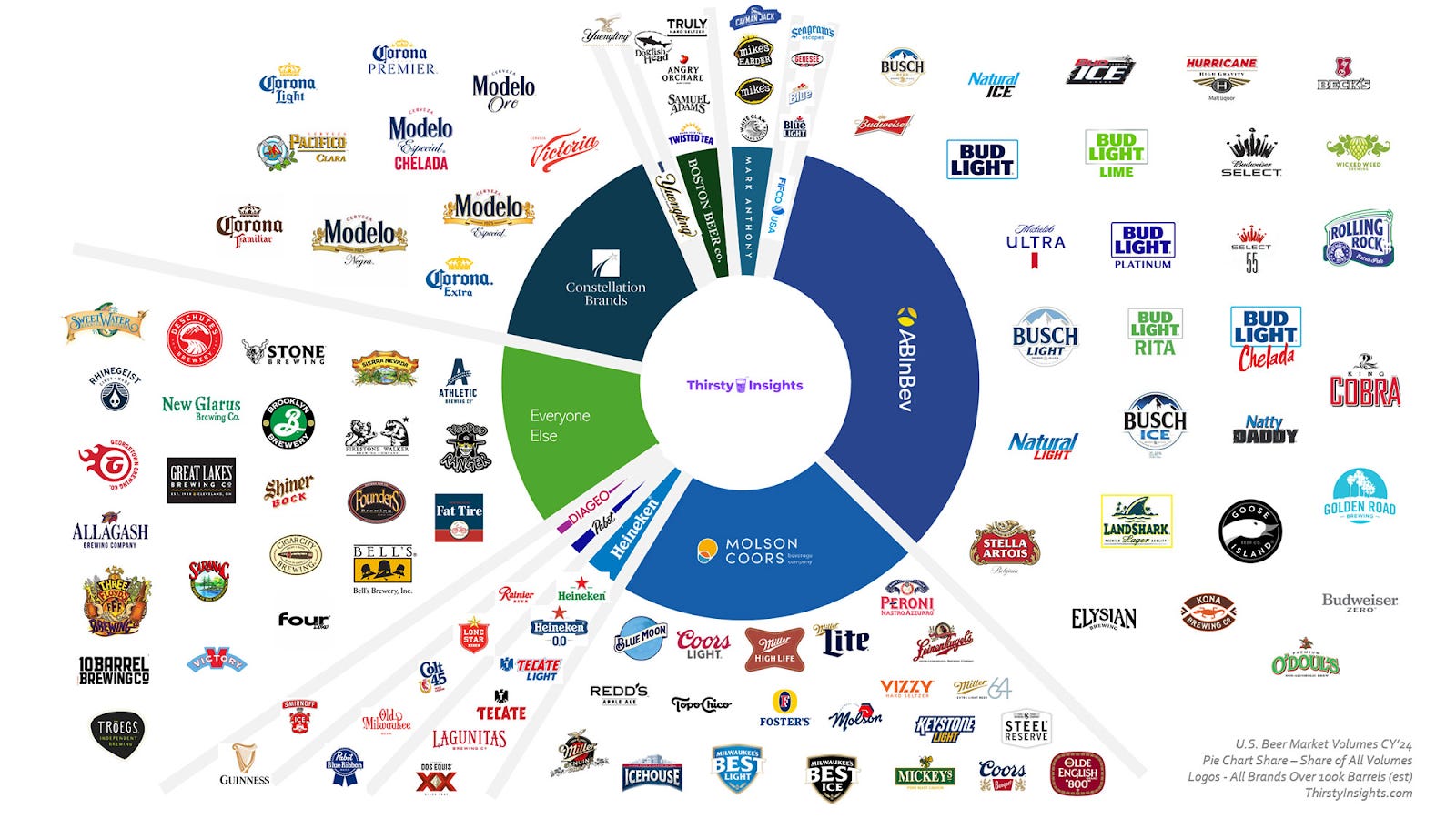
The crucial detail here is how these acquisitions are managed. Many of the breweries that began as craft operations built on local identities continue to operate under their original names, with their original branding. In fact, looking through their website at all, you’d be hard-pressed to find any mention of their new global, conglomerate owners.
Which begs the question: if sustainability doesn’t sell – why keep the locally owned brand?
Now I could end the story here. But there’s one more twist in the irresistible story of craft beer: the acquisitions unravelled fast. Perhaps the most dramatic example is Constellation’s $1 billion acquisition of Ballast Point Brewing of San Diego - a headline deal of the craft acquisition era. Within just a few years, production fell by as much as 20% and multiple locations were shuttered. In a devastating admission from Constellation’s own CMO, Jim Sabia, the company’s “hypothesis was wrong”: it turns out the craft beer segment turned out to be “really local”. Both Molson Coors and ABI have also sold off most of their craft portfolio.
The pattern here is that the conglomerate idea of simply buying the veneer of local, maintained superficially while distributed nationally, didn’t work. The consumer demand for local wasn’t a flavour preference that could be bottled and shipped. It was a relationship with place that dissolved the moment the relationship became inauthentic.
So what does this mean for selling sustainability in travel and tourism?
Up until now, the measure of success in marketing sustainability in travel and tourism has been determined by whether companies can successfully outsource costs of sustainability to consumers by asking them to pay for carbon offsets or determining how many ask about sustainability certification.
Which - let me be blunt - makes no sense. Apathy towards carbon offsets doesn’t mean they don’t care about emissions. It means they don’t think emissions are a premium feature they should pay for. Much in the same way restaurant goers don’t think they should be charged extra to make sure the chef washes their hands. Nor does a lack of initiative around certification indicate it’s not important. Just because I don’t ask to see a pilot’s license to fly, doesn’t mean I don’t care whether or not they can land an Airbus A380.
Just because something matters to a company, or what a certifying body deems important, doesn’t necessarily mean that it matters to the customer.
Craft beer shows that sustainability sells when a brand is able to align their impact around the value sets and aspirations of its customers. To do that, there are a few things you need to get right:
Lead with what your audience already wants. Craft beer identified a desire for authenticity, local connection, distinctiveness – and built brands that spoke directly to them. It put all its other impact aside.
You don’t need to convince anyone that sustainability matters. Instead, find the values your customers care about and highlight exactly how your product delivers on them.
Weave that impact into the brand identity through experience, not reports. It should be something that guests feel, and willingly share themselves, not something they’re educated about.
Be bold about what makes you different. Independent travel brand have an advantage: genuine local connections, relationships, depth of place-knowledge and a kind of authenticity that big conglomerates like the Marriott cannot.
Stop competing on everything. Win on one thing. Craft beer doesn’t win on price, on distribution, or on brand recognition. Corporate brewers beat it on all three. But craft wins overwhelmingly on local identity, community connection and the experience of place. That was enough to build a $130 billion global economy.
The craft beer revolution proved that in an age of global homogeneity, people will pay a significant premium — three, four, even five times the price — for something that could only come from here. That’s the same proposition every destination, every independent hotel, every local tour operator theoretically sells. The difference is that craft beer figured out how to make it real: not through sustainability claims or impact reports, but by embedding place into every aspect of the product, the brand and the experience.
The 4 in 5 consumers who say they want to travel more sustainably probably do mean it. They’re just not going to pay for a carbon offset to prove it. But they will pay for something authentic, local and rooted in place — the same way they’ll happily pay $12 for a craft beer that costs $3 to make, while ignoring the $4 Heineken sitting right next to it.
Outlier is brought to you by Equator - an advisory company specialising in tourism data and forecasting traveller trends. We help travel brands anticipate demand and demonstrate impact, so more travellers choose them.