
Tourism isn't slowing down. It's accelerating.
Amidst the concerns over uncertainty in travel and tourism, data tells a very different story around what's about to happen next.

2024 was a difficult year for travel in Europe. There were hunger strikes against tourism developments, local councils threatened to cut off water to unlicensed vacation rentals, and in Barcelona, tourists were sprayed with water pistols in protest against the impacts of overtourism. By the end of summer, Ceylan Yeğinsu from the New York Times asked ‘Was this the summer European tourism reached a breaking point?’
Fast forward six months and many media outlets are warning of the impacts of a recession in travel and tourism. And for good reason too: the combination of stagnant wages, the high cost of living, continued inflation, rising nationalism, uncertainty around tariffs, and an overheated market is making investors nervous.
So which is it? Is tourism about to break Europe? Or is all this talk of ‘overtourism’ overblown? Let’s find out.
A little bit of history.
To understand the origins and driving force behind the tourism crowds, we have to go back to the 1950s. This was a different era of travel: planes served lobster, had legroom, flight crew offered near endless cocktails, and Marilyn Monroe was seemingly on every flight. Little wonder it’s often described as a ‘golden age of travel’.


Except that for most people, it was neither ‘golden’ nor ‘an age of travel’. Because in 1950, most people couldn’t afford to take a vacation, much less book a seat next to Marilyn Monroe.
If you wanted to travel to Cyprus in the 50s, for instance, you’d need to earn around US$147 per day, adjusted for inflation (Equator). There were less than 836k people on the planet who made that much money. That was less than 0.5% of the world’s population (World Bank).
The majority of people in 1950 were earning between $1-$2 a day. Today, that’s described as ‘living in, or near extreme poverty’. Survival - not travel - is the primary concern of most households. To picture what the state of the world’s income back then, Equator put together the graphic below with a little help from Gapminder.
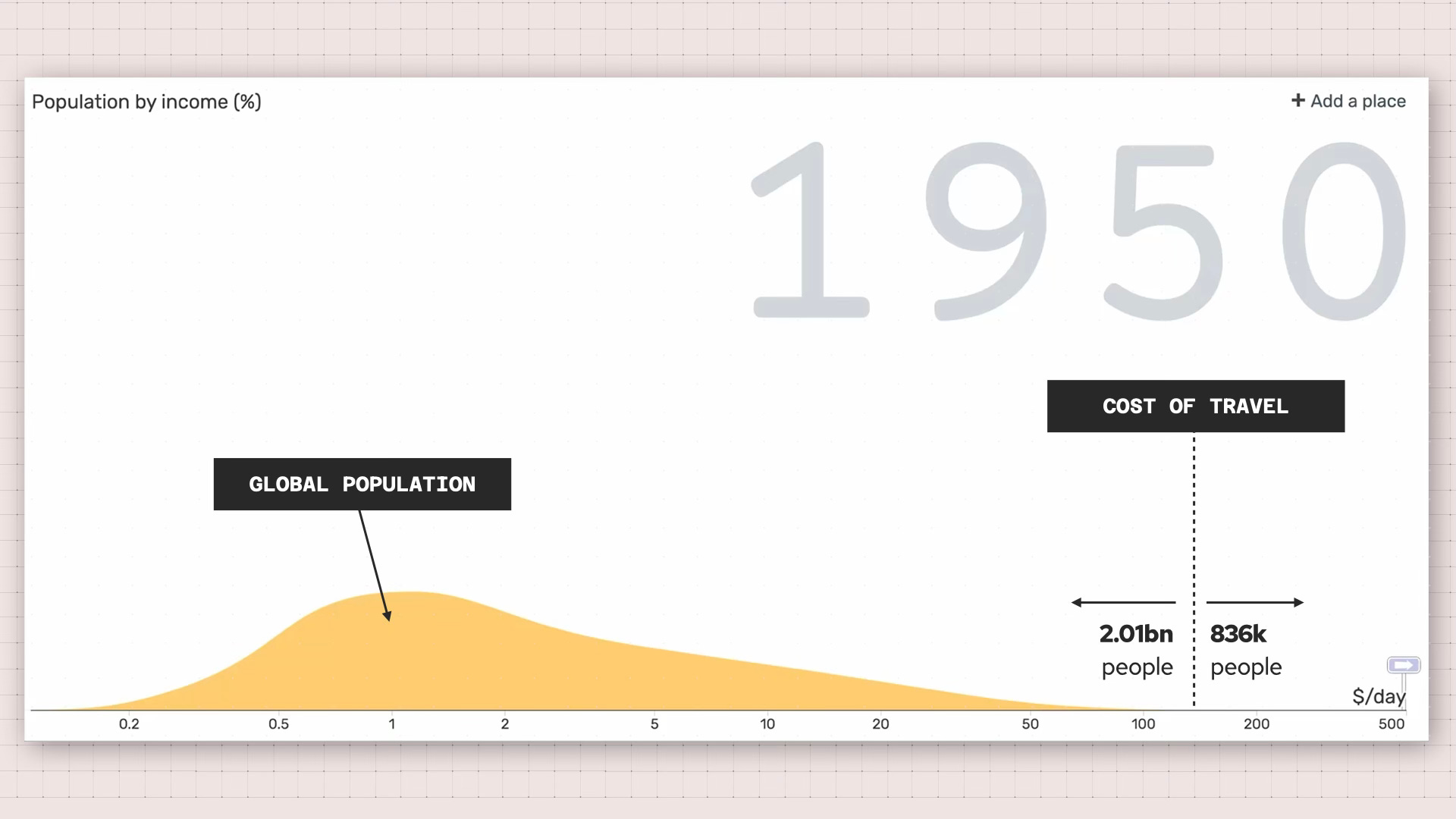
The yellow mountain? That’s the world’s population displaced by daily income. The cost of travel in the 50s is set at $147 a day. To convey just how inaccessible travel was in the 1950s, there are so few people earning more than $147 a day that they’re not even visible in the visualization.
Over the next 75 years, however, that changed. Improvements in healthcare and social systems meant the global population exploded. Advancements in technology, access to education, investment in infrastructure, and new legal frameworks meant travel became more accessible and more affordable than ever. The income required to take a vacation to Cyprus dropped from $147 to just $57 per day and as a result, the number of people who could afford to travel went from 836k to over 670m by 2025.
Click play on the video below to see an animation of this happening:
This is why everywhere feels so much more crowded: there are more people, making more money, buying something that’s become a lot more affordable. Travel and tourism has become increasingly more affordable and accessible.
Recessions don’t change the trajectory of growth.
Given the extraordinary growth of travel and tourism, you’d might be forgiven for thinking that a recession is exactly what tourism needs. A global economic downturn will reduce visitor spending and ease pressure on destinations, housing markets and attractions. Right?
Well, no.
According to the World Bank, the world has experienced four global recessions in the last seventy-five years: in 1975, 1982, 1991 and 2009. During each of these episodes, “annual global GDP per capita contracted, and was accompanied by a weakening of other key indicators of global activity”. Mapping those recessions against arrivals, however, it’s hard to pinpoint any major disruption to travel and tourism other than COVID-19. While there are fluctuations and some dips, there’s one very clear direction of visitor arrivals in the last 70 years: up.
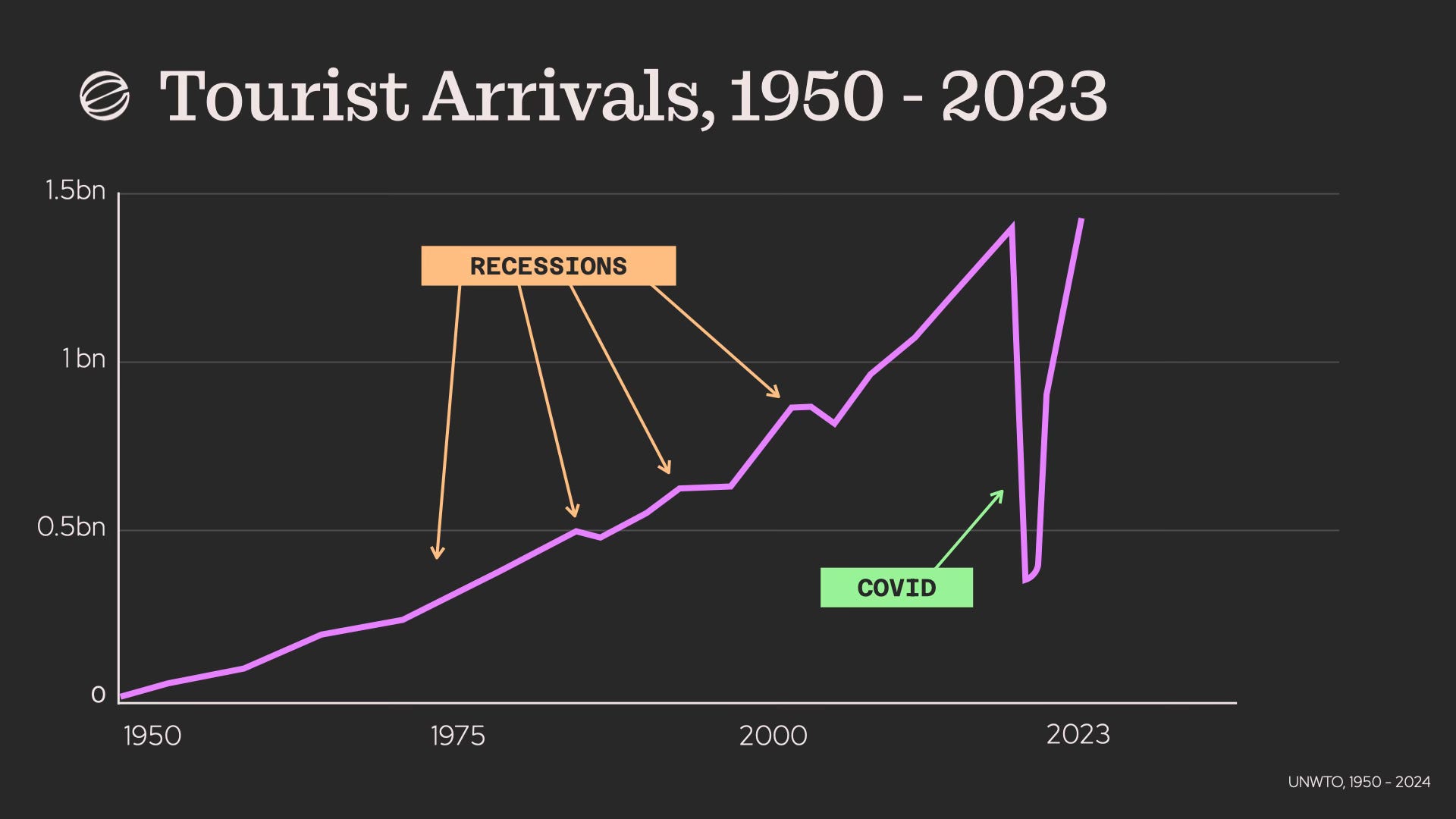
That isn’t to say that travel is recession-proof. It’s just that in the face of extraordinary macroeconomic forces, recessions don’t change the broader trajectory of the industry. In fact, recent studies have found that during economic hardship and higher costs of living, travel continues to be one of the fastest-growing areas of consumer spending.
Between 2023-2024, the management consulting firm McKinsey reported that just 15% of their survey respondents stated they were trying to save money by reducing the number of trips they go on. (Mckinsey, 2024)
The industry is incredibly elastic. In the aftermath of the 2009 global financial crisis, for instance, from 2010-2019 it grew by 60%, outperforming both the mining and banking sectors during that same period.
Travel is just getting started.
This is where things get really interesting (or terrifying, depending on your outlook). First, there’s no sign of tourism’s growth slowing. Short of total economic collapse, global climate catastrophe or a global war (admittedly these feel increasingly likely these days), growth in travel is set to continue.
If it does, then the number of people who cross that ‘threshold of affordability’ over the next 25 years will increase by almost 500 million (or the entire population of Europe). To put that in perspective, that’s the entirety of tourism’s growth over the last century, almost doubled, in a quarter of the time.
The next 25 years in travel and tourism
That’s the conservative projection. The model above assumes that the affordability of travel remains the same, which is unlikely. The average cost of air-travel-per-kilometer has dropped by as much as 40% from 1993 to 2019. Given the promise of AI in boosting efficiencies and productivity, there’s every chance that travel becomes even more affordable. A 10% improvement in affordability over the next 25 years would an additional 200 million people.
The cost of air-travel-per-kilometer has dropped by as much as 40% in the last 25 years (US Bureau of Transportation Statistics)
The other major variable in this model is that as income goes up, households travel more. According to research company Arival, wealthy travelers account for a disproportionate share of bookings. Despite making up 20% of all travelers, they represent a third of all bookings and almost 50% of total spending on tours. In other words, the more money we make, the more we travel.
Last year wasn’t some sort of ‘peak travel’. No. We’re just getting started. Which begs the question: if the New York Times are wondering whether Europe is at a breaking point today, what happens in 2050, when the number of tourists worldwide doubles?
Final Thoughts
You’d be forgiven for being cautious about the future of travel. The New York Times, BBC, and Forbes have all penned articles about concerns travelers have over visiting the US. Coverage of an imminent 'recession’, ‘stagflation’ and the emerging global trade war appear to be causing further disruption (Google Search Trends reveal that coverage of the term ‘recession’ in the news now exceeds the levels of news coverage during COVID-19). It all feels very…uncertain.
That is precisely why I wrote this article. We shouldn’t be uncertain about the future of travel. Its continued growth is almost inevitable. In just three generations, the industry has gone from being an economic past-time of the super rich to a global economic force that supports the livelihoods of 300 million people around the world (1 in 11 jobs) and contributes over US$11 trillion do the global economy. During which period, recessions, global financial crashes, and global conflicts have barely registered (in terms of visitor arrivals and visitor expenditure).
What keeps me up at night isn’t the idea of a recession. It’s the idea that the decision makers at destinations, at corporations, in government and industry associations are worried about short-term uncertainty they have little control over, rather than laying the groundwork for what we know is going to happen next.
🍕🍔 🍟 Takeaways :
The causes of overcrowding are macroeconomic, technological and demographic change, not Airbnb and Instagram.
Historically, recessions have had very little impact on travel and tourism.
Don’t let lower-than-expected quarterly reports and short-term uncertainty distract you from the major threat to travel: inexorable growth.
Super interesting, thank you!