
Why consumers have never really bought into corporate sustainability claims
And what it says about the recent backlash to sustainability marketing

Over the last couple of years, there’s been a significant corporate shift away from sustainability. British Petroleum slashed its environmental targets by 15%. Nike laid off dozens of sustainability managers as part of a cost-cutting initiative. Unilever abandoned its pledge to pay its suppliers a living wage by 2030. Microsoft, meanwhile, was among 200 companies delisted by Science Based Targets Initiative (SBTi), an organization that helps companies set targets aligned with climate science aligned to the Paris Agreement.
So what’s going on? Why are corporations suddenly changing their mind about sustainability?
It’d be easy to blame Trump. And it’s true to say the political climate has given some cover. But most of these rollbacks began well before the 2024 election. A more common explanation is the ‘intention-action’ gap. Described by Harvard Business Review as the disconnect between what consumers ay and what they actually do. According to the paper, two-in-three consumers claim they want to buy from purpose-driven brands, but only about a quarter actually do. A similar study was published by Phocuswright, that found travelers rarely follow through on their green claims.
For many corporations, this phenomenon has become a convenient retreat: if consumers won’t pay for sustainability, why should brands? But that begs the question, is the fault really with the consumer, or with how sustainability was built and marketed to them?
Let’s find out.
The origins of the corporate sustainability movement
To understand where we are with corporate sustainability today, we need to go back (just briefly) to its beginnings.
Although the roots of the movement stretch back to the 1970s, it wasn’t until the 1990s that sustainability entered the mainstream. A series of high-profile environmental disasters, including the 1989 Exxon Valdez oil spill in Alaska and the oil fires during the first Gulf War, ignited public outrage and exposed the global costs of corporate negligence and fossil fuel dependency.


The first major landmark for the climate movement was in 1992, at the Rio Earth Summit. Over 170 countries convened to create the United Nations Convention of Climate Change, the foundation for global environmental governance. Just five years later, in 1997, this evolved into the Kyoto Protocol, which marked the first legally binding agreement among industrialized countries to reduce greenhouse gases.
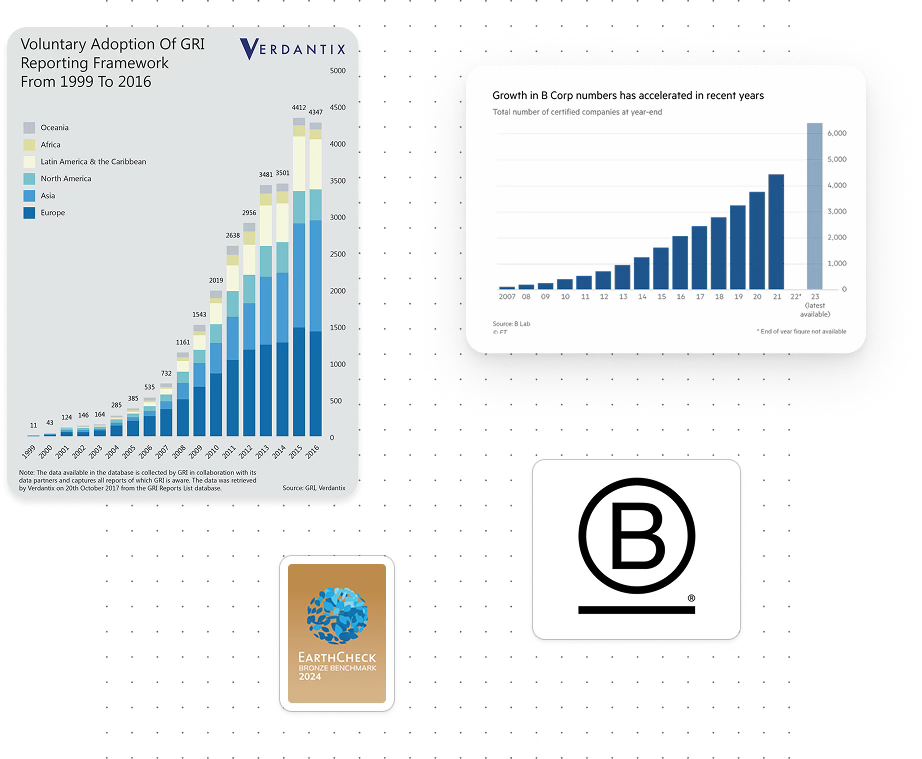
That same year, to hold corporations to account over their impact, the Ceres and Tellus Institute launched the Global Reporting Initiative (GRI). The idea was simple - give large corporations a standardized approach to measurement and reporting on environmental, social and governance issues so that they could be held accountable. Within just five years, over 100 global corporations, including Ford, Nike, Shell, BP and Novo Nordisk had begun reporting using GRI.
Despite the promise of the Kyoto Protocol, government action was limited or non-existent. The United States refused to ratify the agreement, and by the early 2000s, had formally walked away from it. With regulators on the sidelines and public skepticism growing (particularly as greenwashing became more prevalent), pressure mounted for some form of corporate accountability. Enter third-party certification bodies. By the late 2000s, organizations including BCORP, Fairtrade, the Rainforest Alliance, and LEED had become mainstays offering a new kind of credibility: independent verification.
Over the next two decades, corporate disclosure and certification systems grew rapidly. As of 2025, 96% of the world’s 250 largest companies report on sustainability, and membership of organizations like BCORP have grown from several hundred to over 6500.
Sustainability marketing was borne from a need to validate
As public pressure for corporate responsibility mounted, companies turned to disclosure not just as a tool for transparency, but as means of boosting sales. The logic was simple enough: if consumers cared about the planet, then proving our brand cares too will unlock sales. Certification bodies, recognizing an opportunity to expand their influence and revenue, were happy to promote the idea.
And so, by 2010, sustainability marketing had gone mainstream. Corporations had repackaged the pie charts and technical jargon of their 200-page ESG reports into marketing content.
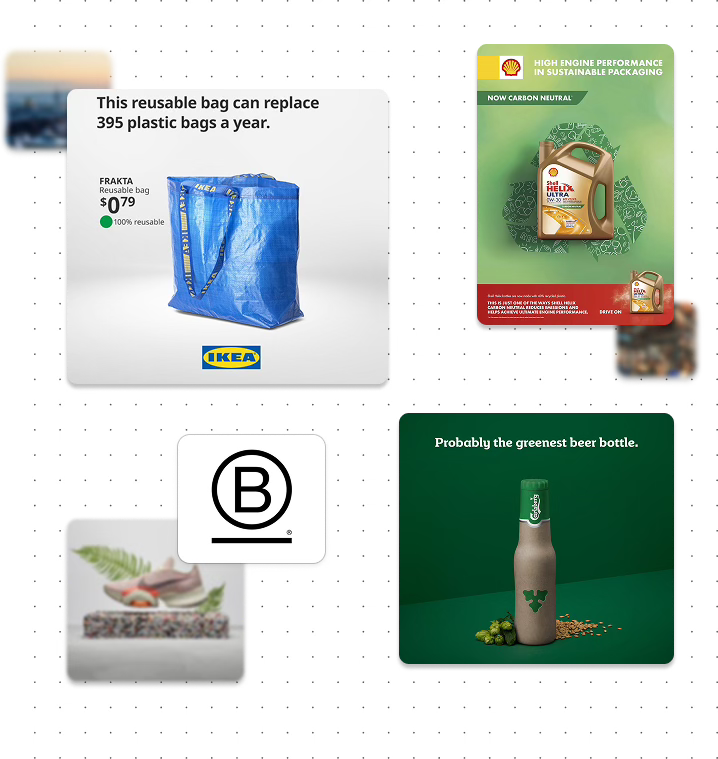
The world’s single largest corporate polluter, Shell, unironically began selling high performance engine oil as carbon neutral. IKEA sold a plastic bag as an opportunity to replace other plastic bags. HP began putting ‘ocean-bound plastic’ into their laptops. Cruise-liners claimed that food waste was ground up and turned into ‘fish food’. While Ryanair (in true Ryanair fashion) decided - without much effort or evidence whatsoever - casually decided to declare itself as the world’s lowest emission airline.
So why didn’t consumers buy into the claims? What went wrong with the corporate logic?
Reason #1 - ‘Slightly better’ isn’t good enough.
For most companies, sustainability wasn’t a transformation, it was a retrofit.
Rather than fundamentally reimagining supply chains, operations and systems, most companies simply kept the engine running and tweaked the impact. Disclosure frameworks and ESG reports became a way to showcase directional progress: slightly less plastic, slightly fewer emissions, slightly better wages.
Corporations assumed that if consumers saw movement - even incremental - they’d be satisfied.
“The customer isn’t a moron. She’s your wife.”
David Ogilvy
Turns out they were wrong. Corporations underestimated the intelligence and intuition of the modern consumer. Perhaps because the idea that Coca Cola’s PET plastic initiative isn’t all that impressive when staring at a vending machine filled with single-use plastic bottles. Or H&M’s ‘Conscious Collection’ requires navigating countless racks not part of that collection (presumably called ‘not-conscious collection?).
Well-intentioned as sustainability initiatives might be, they don’t (and shouldn’t) obscure reality: there’s a big difference between a product built to solve a problem and one that’s simply been rebranded to soften its harm.
Before corporations and market research firms declare sustainability isn’t a priority for consumers, they should try creating transformationally sustainable products first.
Reason#2 - The customer, not the company, is the main character
In their rush to prove they were doing the right thing, most companies turned inward and focused on validating their efforts. Executives assumed that if they list carbon offset figures, announced Scope 3 assessments, and plaster eco-labels on packaging, they’ll increase market share by showing consumers they’re ‘taking sustainability seriously’.
“People don’t buy products. They buy versions of themselves.”
Seth Godin
As rational and data-driven as this approach was, it was fundamentally misaligned to how consumers think. Consumers don’t support brands to reward them for their sustainability efforts. They support brands because of what that brand says about their personal identity. It’s what made Apple’s ‘Think Different’ campaign so bruilliant; rather than asserting the technical specification of the G3 or the iPod, it celebrated the type of person that buys Apple products. It’s why Spotify Wrapped was brilliant. Why Patek Philippe’s tagline (a brand almost no one can afford) is so well known.


By focusing on low-flush toilets, carbon-offsets and the quantity of recycled plastics, sustainability branding failed to give consumers any meaningful reason to support them. They forgot that the company is not the main character, the customer is.
Rather than emphasizing ‘look how much we care’, what they should have done is say ‘look what this choice says about you.’
Reason #3: Sustainability is framed to fail.
Finally, the way sustainability has been framed has been a near-guarantee that consumers would reject it.
In 2023, Deloitte found that 60% of consumers think sustainable products are significantly more expensive, even when differences in price are small. This isn’t because sustainable products should inherently cost more, but the result of retrofitting sustainability onto existing corporate operations. Carved out as niche product lines, ‘sustainable products’ rarely benefited from economies of scale. And whatever emissions were produced, were simply passed on to the consumer in the form of an offset.
Before someone argues that designing sustainable products is inherently more expensive, let me remind you that' we’ve subsidized fossil fuels to the tune of $trillions while claiming their ‘efficiencies’. Redirect a fraction of that into supply chain innovation, robotics, material R&D and that ‘cost’ of sustainable production doesn’t look expensive, it looks inevitable. Just ask the auto industry what happened after they stopped laughing at Tesla (admittedly…before we all started shouting at Tesla).
Even when cost isn’t an issue, sustainable products are almost always harder to buy. Consumers are asked to ‘opt-in’ to carbon offset programs, to filter for low-impact products, or have to check the bottom shelf to find the compostable goods. At a time when every user-interface and experience designer is trying to make it faster and easier to click ‘buy’, sustainability has gone in the opposite direction.
“The human brain does not run on logic any more than a horse runs on petrol.”
Rory Sutherland
Ultimately, the ‘better choice’ for the planet comes at the cost of experience. We invite consumers to ‘skip the beef option’, ‘opt for low-flow showers to reduce water consumption’ and use plant-based dishwasher soaps - however ineffective they are. In a world where corporations are making - at best - marginal improvements to their supply chains, why are we expecting the consumer to give something up?
In the end the problem, as advertising strategist Rory Sutherland put it, is that “We are not logical creatures, we are creatures of meaning”. Emotion, not calculated reason, drives purchasing decisions. So when framed as an appeal to our sense of personal guilt, are we all that surprised that sustainability marketing hasn’t worked?

The result? Public indifference skepticism
Corporate sustainability marketing has broken almost every rule in traditional brand marketing. Instead of creating products that sell themselves by forging emotional connections with consumers, sustainability efforts focus inward. They emphasize corporate virtue over customer benefit.
The race to label the impacts of products with technical jargon (e.g. CO2e kg.day) has - unsurprisingly - overwhelmed consumers. Studies by Expedia and Amcor have shown that between 70% and 80% of consumers are either overwhelmed or confused by sustainability labeling. The difficulty consumers are having in decoding sustainability claims has, according to Deloitte, limited their willingness to pay more for sustainable products.
Public displays of corporate validation - awards, ESG reports, and virtue-signaling - have, at best, created a dangerous kind of public apathy. At worst, they have triggered skepticism and a rising backlash that actively undermines genuine progress made by the firms truly committed to mitigating the harmful impacts of growth. Research conducted by the European Commission found that half of companies exaggerated their claims or failed to provide evidence. It’s unsurprising then, that Kantar reported that over half of consumers say they’ve seen or heard false or misleading sustainability claims from brands.
Right market for the wrong seller.
The ‘intention-action gap’ exists because consumers aren’t buying ‘good intentions’ from corporations largely responsible for the current crisis we’re now in.
Corporate sustainability marketing didn’t fail because people stopped caring. It failed because corporations retrofitted sustainability onto business-as-usual. They opted for incremental improvements to existing systems, over a fundamental overhaul of how their products were designed and built. Conscious of the inherent contradiction between real impact and perceived brand, executives saw validation as the best and only strategy to convince consumers they cared.
The problem was that this strategy - however logical - broke every rule in marketing. Consumers were never going to believe that a bottle of engine oil made of 40% recycled plastic by Shell absolves them of their 590 million tonnes of CO2e per year (that’s 1.5% of total global emissions btw). Nor does an emotional appeal based on ‘marginally less guilt’ give consumers something to aspire to.
But imagine consumers were offered a real choice. Not a slightly-less-harmful version of the status quo, but a product actually built to solve a problem, from a brand people want to be a part of, that speaks to them in the same way we market everything else: with aspiration, emotion, and clarity. In that scenario, it’s hard to imagine consumers would continue with the status quo.
Corporations were right to think the sustainability is a brand differentiator that offers huge market appeal. But they were wrong to think that market was for them. The future of sustainability marketing doesn’t belong to legacy brands, but to small businesses. Businesses that can build their products that align impact with consumer values and write the stories that resonate.
Right now, as corporations retreat from sustainability under the political cover of MAGA and the claim that “public apathy” justifies divestment, small brands and startups have a choice: do they follow their corporate counterparts, or see corporate failure for what it is - an opportunity to go after arguably the largest untapped market in modern history?
Want to know how small brands are already doing that? Hit like and subscribe - we’lll unpack that in the next article.