
Your customer's motivation to visit is your crisis insurance
Why your customer’s intent is the single best predictor of how fast your tourism business will recover from the next shock

If you’re running a tourism business in 2026, and wondering how the current crisis in Iran, fear over the global financial market, or the impact of climate change might impact your business, and are looking for resiliency, then this is for you.
The key takeaways:
One of the most important things you can do as a tourism business is to understand your customer intent. Why do your customers choose YOU specifically? Can what you offer as a business, or destination, be easily replicated elsewhere?
We looked at data from several academic studies covering tourism crises from the last 30 years, and we discovered a pattern. Travellers return in a specific order, and that order is determined by what their motivation to visit is.
Knowing which groups the majority of your customers fall into will help you anticipate how your business could be affected should a crisis hit your destination, and how fast you could expect to recover business back to pre-crisis levels. It could mean the difference between taking 1-2 years to recover or 5 years to recover.
The main things you need to do right now are: a) find out your customer intent through surveys, or looking at data you already have. b) map the markets you’re not in yet that could help you rebound more quickly. For example, if you are in a place with a large diaspora population, could you entice them to stay with you (even for a weekend getaway) instead of their cousin’s house? c) Invest, right now, in making your product harder to replace. More details on how to do all this is below.
The mojito test

The most overlooked question in travel marketing is “why did your customers pick you?”
If they say “to sit in an infinity pool, holding a mojito, and escape from the world”, then I think in a moment of crisis, a company has a problem. Not because the product is bad, but because the intent behind the purchase is generic. If the customer wants to feel pampered and relaxed in a beautiful place and have someone bring them things, that can be fulfilled by approximately four thousand properties in sixty countries. An infinity pool in Dubai, the one in Bali, the one on a Greek island — they’re all solving the same problem. The mojito is interchangeable, and so is the destination.
Now think about the customer who’s coming to summit a mountain over 8,000 meters. Or the family flying in from Detroit to see their grandmother in Muscat. Or the family whose children are obsessed with Dune, and want to see Wadi Rum, Jordan, where much of the movie was filmed.
There are few (if any) substitutes for these experiences. Their intent is locked to a place, a person, or an experience that exists nowhere else. These are the customers that come back first after a crisis hits, whether it’s a geopolitical event or natural disaster.
Knowing the motivations behind travellers' decisions is the basis on which you can predict (in the event of a crisis) when travel will pick up again.
The travellers who come back quickest after a disruption are the ones who came for something they can’t easily get anywhere else. Their reason for being there is specific and irreplaceable. The ones who take the longest to return are those with no strong attachment to the place itself; they just wanted a holiday, and any destination would have done.
What the data says
We’ve spoken to several tourism businesses since the war on Iran broke out. Many are worried and asked: “how long can my business survive when tourists have stopped arriving at my destination?”
They know that at some point, and as history tells us, arrivals will recover. But when you’re running a business, you need something more immediate and concrete than that. A vague reassurance isn’t going to bring back your cash flow. You want to know what you should be doing now to mitigate the pressure on your business, and what moves you can anticipate that tourists, especially your biggest customer segments, will make in the aftermath of a crisis like the recent war.
So we assembled a dataset of 18 discrete tourism crises from the last 30 years: wars, terror attacks, pandemics, natural disasters, revolutions, diplomatic blockades. Then we looked at how different traveller segments behaved in each one.
We found that the pattern is remarkably consistent across very different kinds of crises, in very different parts of the world. Travellers return in a specific order, and that order maps almost perfectly to how substitutable their trip motivation is.
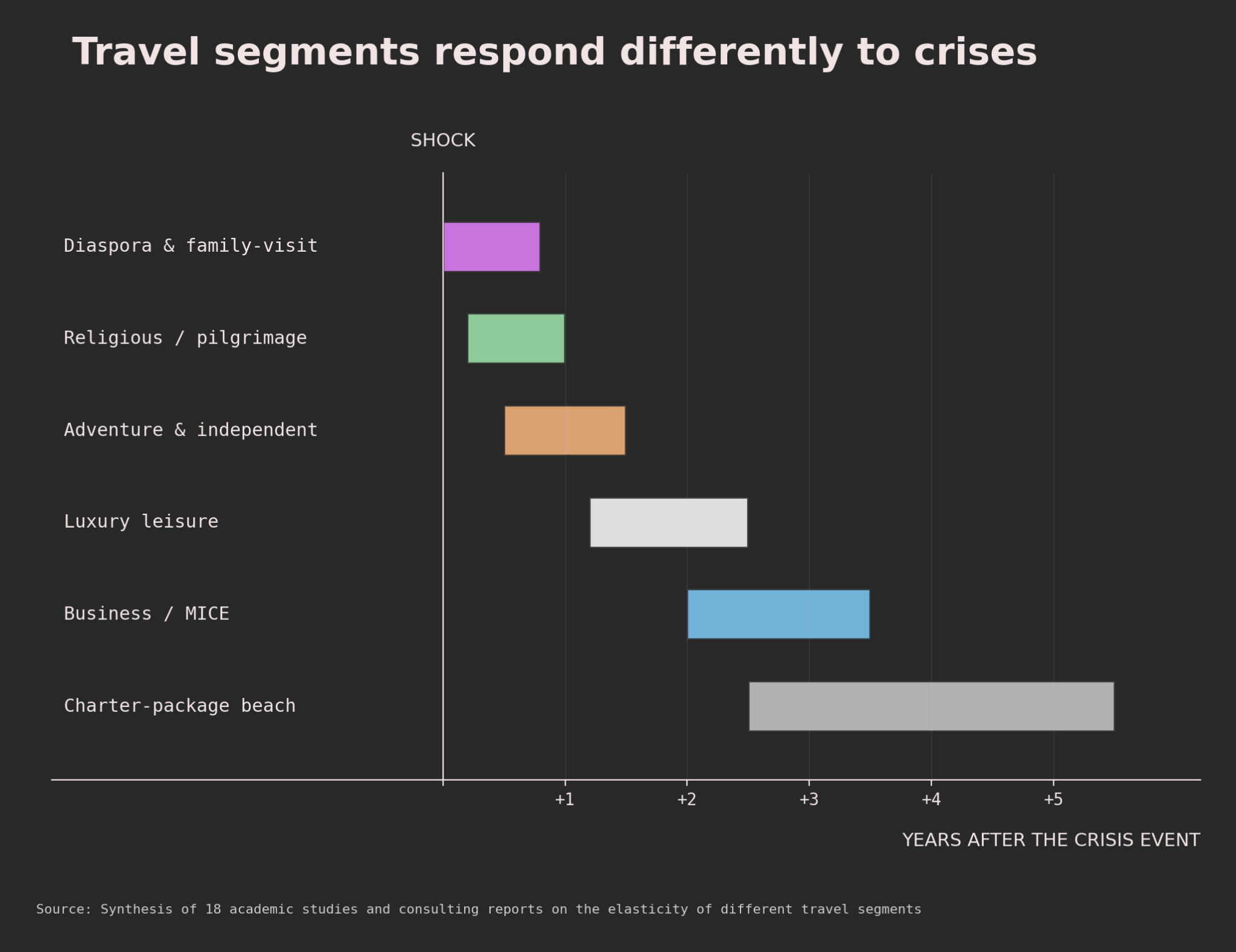
Diaspora and family-visit travel moves first.
This is the most substitution-proof segment that exists. There is no alternative to going home. Academic research identifies visiting friends and relatives (VFR) as a “first-mover” market segment for crisis recovery (Backer & Ritchie, 2017, International Journal of Tourism Research). Lebanon’s record-breaking 2009 tourist season — up 43% from 2008, just three years after the Israel-Hezbollah war — was driven overwhelmingly by returning Lebanese expatriates. During COVID, VFR accounted for 73% of domestic tourism activity in South Africa while other segments were still grounded.
Religious and pilgrimage travel moves second.
When Saudi Arabia lifted its COVID Hajj restrictions, pilgrim numbers surged from 1,000 (2020) to 60,000 (2021) to 1 million (2022) to 1.8 million (2023). Pilgrimage demand doesn’t disappear during a crisis, it just accumulates. The International Journal of Religious Tourism and Pilgrimage found that “the demand for pilgrimage seems to increase during times of hardship and uncertainty.” There is only one Mecca, one Jerusalem, one Varanasi.
Adventure and independent travellers are the first leisure segment back.
Adventure recovers three to four years ahead of mass travel. An IMF study (Behsudi, 2020) found that travel recovery is “kickstarted by the less risk averse travellers and early adopters, from adventure travellers and backpackers to surfers and mountain climbers.” Research by the Adventure Travel Trade Association and Euromonitor International quantified this: adventure travel spending recovered to within 7% of its 2019 baseline by 2021, while the overall US travel market didn’t reach that level until 2024. After the 2015 Nepal earthquake, trekking routes were declared safe by late 2015 and Intrepid Travel exceeded pre-earthquake traveler numbers by 2017. After the 2002 Bali bombings, the early returnees were “surfers, backpackers, budget travellers, Bali ‘faithful’ and simply curious” (PATA).
Luxury leisure is fourth.
This is the finding that surprises people, because it’s the opposite of the “luxury is recession-proof” narrative. Luxury leisure travellers (different from luxury business or luxury pilgrimage) are among the most substitutable travellers in the entire tourism economy. A couple with $40,000 to spend on a week away by the sea have seemingly endless options. They can go to the Maldives, the Seychelles, Bora Bora, Positano, Oman, or a private island in the Caribbean. They have the time, the money, and the flexibility to wait for someone else to validate the destination first. Skift’s 2026 Middle East recovery framework identifies the sequence explicitly: “the recovery flywheel begins with diaspora and VFR traffic” before “luxury repeat visitors return next, generating high-yield revenue that funds continued marketing.”
Business and MICE travel lags further.
It books 6 to 18 months forward, so it responds not to today’s safety but to the perceived safety of the conference date. McKinsey measured this precisely after the 2008 financial crisis: international leisure travel from the US recovered in two years; international business travel took five.
Charter-package beach tourism is always last.
It’s pure commodity: the tour operator doesn’t care whether it sells Tunisia or Greece or Spain, only whether the charter seats fill. After the 2015 Sousse attack in Tunisia, British tour operators “immediately pulled the plug on their Tunisian operations, and charter flights from the UK abruptly ceased.” British tourist arrivals dropped 92.3%. Recovery to the 2014 baseline took five years.
Bottom line: the more your revenue depends on customers whose motivation is generic (escape, relaxation, a nice time in a nice place), the longer your recovery will take. The more your revenue comes from customers whose motivation is specific to you, the faster you’ll bounce back.
What to do about it
If you’d like help building a customer intent framework or crisis-resilience audit for your business, reach out to me at hello@equator-ai.com or find me on Linkedin.
Knowing this pattern exists is useful. Knowing where your own business sits within it is essential. Here are three things that any tourism operator, whether you’re a boutique hotel, a DMC, a tour operator, or a destination marketing organisation, can do right now:
