
Right now, someone is editing you out of their holiday photos
Why tourists want to avoid being around other tourists.

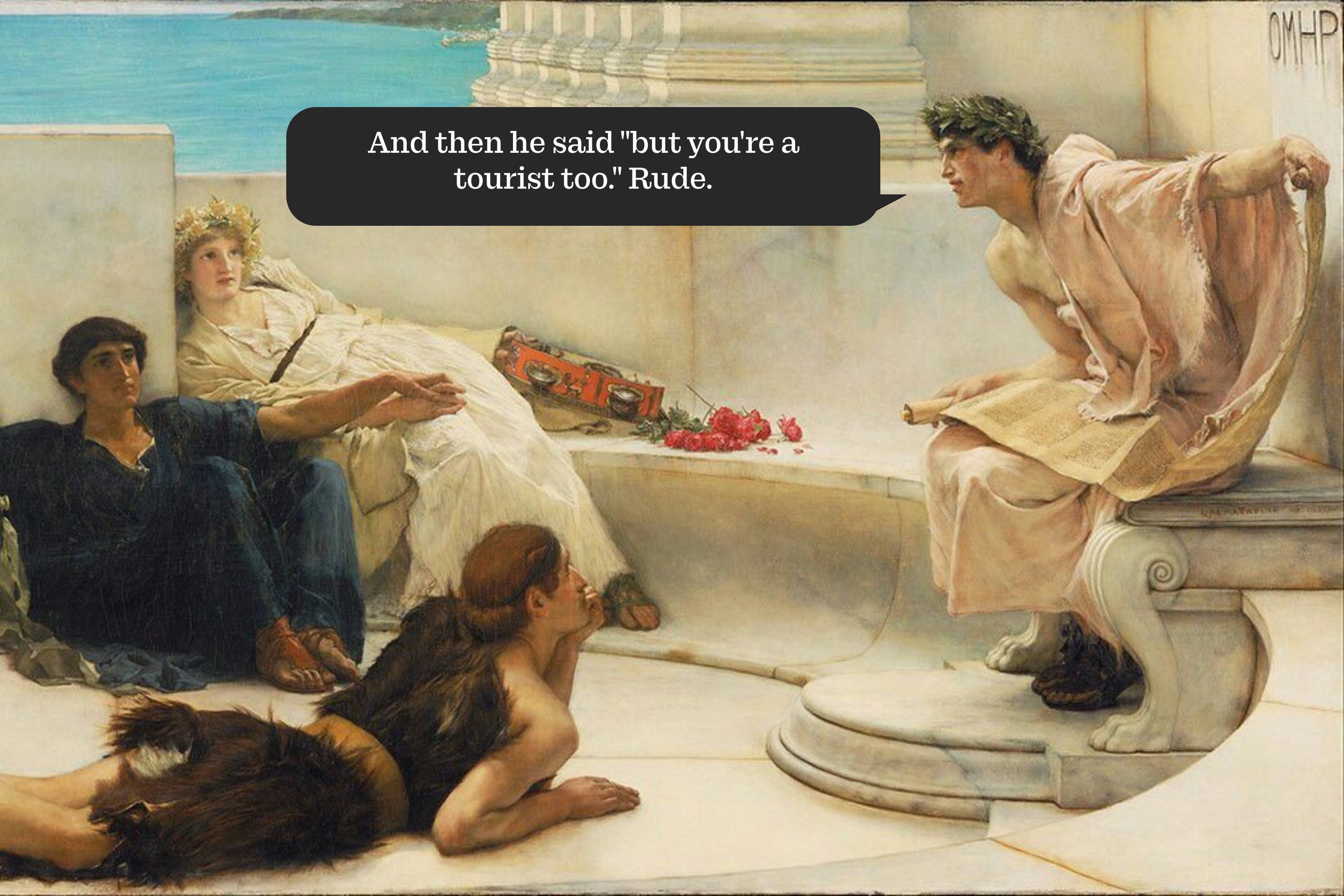
Open Instagram, scroll the travel tag, and you’ll find hundreds of photos of famous places with no other tourists in them. The Trevi Fountain at 11 am – somehow deserted. There’s apparently one person in the Tegallalang Rice Field in Bali. And that rooftop sunset photo in Santorini? Just you, in a nice dress.
Some of these are real. The photographer probably got up at 5 am to be able capture that people-free shot. Or maybe it was an off-season visit that got lucky with a sunny day in February. Most photos at big tourist attractions these days, however, are not. They’ve been scrubbed by Adobe’s new ‘Generative Remove’, Google’s Magic Eraser, or one of the many other crowd-removing features on the App Store.
So why do we do this? Why is it that – when it comes to vacations and holiday photos – we want to eliminate any sign of other tourists being there?
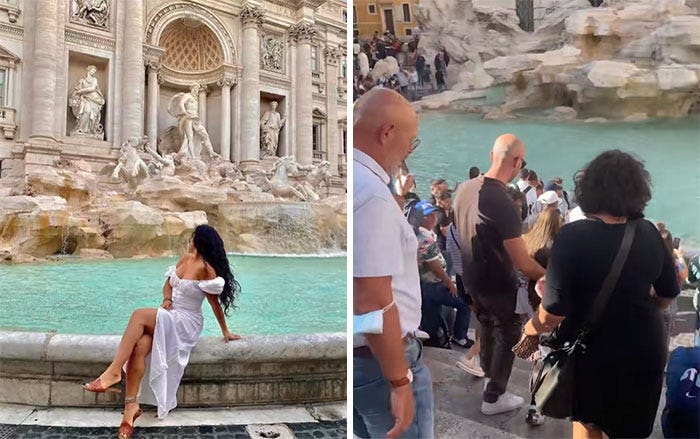
This phenomenon isn’t limited to photos either. Just the other day, I boasted to a friend that I’d stumbled on a small restaurant in a back alley in Barcelona in which there were no other tourists. Puzzled, she replied: “Edmund, why is that a brag? What’s so bad about restaurants with tourists? Aren’t you a tourist?”
An aversion to other tourists isn’t entirely irrational
I love being in places other tourists aren’t. The irony of my working in tourism while avoiding tourists notwithstanding, my preference for quiet, undiscovered places isn’t entirely irrational.
It has to do with a concept economists call ‘negative network externality’. In its simplest form, this is where the more people consume a good or service, the worse the experience of its consumption gets for everyone.
Usually, most goods and services - especially tech - benefit from positive network externality, meaning that the more people use them, the better they get. But tourism isn’t like that.
Unlike dating applications or streaming services, tourism services are restricted by time, quantity and space. There are limits beyond which services worsen or begin to break. This is perhaps most evident on Everest, where hundreds of people queue in an attempt to summit the mountain. Or among the thousands of people desperate to get a glimpse of the Mona Lisa. Every additional person joining a queue makes the experience marginally worse for everyone else.
In most industries, soaring demand isn’t much of a problem. If membership at Netflix soars, they just add more servers. If orders for the latest Toyota exceed expectation, then the factory simply increases its production output. Tourism, however, does not work this way. You can’t put a 20-story hotel in the centre of Venice without ruining the city’s charm. There’s only one Everest, and not much room on it. And unlike Toyota, the Louvre can’t just manufacture another Mona Lisa.
There are limits to travel and tourism, at which point the quality of consumption worsens.
The hidden cost of managing crowds: optimising for mass appeal
The effects of negative network externality extend beyond just congestion, queues, and crowding. There are more subtle shifts.
In an effort to appeal to as many tourists as possible, popular restaurants begin changing their menu design, offering blander versions of once popular local dishes.
To reduce the footprint of a standard room, hotels remove desks and built-in wardrobes, investing more in ‘shared spaces’, while simultaneously adding 100 new rooms to their inventory. While in Florence, you spend as much time staring at reviews and maps on TripAdvisor or OpenTable as you do in the restaurant itself.
To accommodate the increasing number of travellers, the industry has been forced to find a more efficient way of managing the flow of people, what’s known as “optimising for throughput”. Exhibition halls that once promised a quiet, solitary engagement with Botticelli’s Primavera are rearranged to accommodate larger tour groups at a single time. Restaurants begin enforcing timed entry and exit for bookings. Even sun loungers are now a hot bed of political sensitivity (pun absolutely intended).
The logical endpoint for this process of optimisation should be familiar: sameness. It’s the hotel lobby that could be in Singapore or Stockholm. Or the breakfast buffet that offers tomato, olives, cold cuts and, inevitably, overcooked scrambled eggs that flop depressingly on your plate. Sure, it’s convenient. And the crowds might be easier to navigate. But in the process of optimising for throughput, we’ve removed the differences that I think make places feel special and unique.
This is why negative network externality effects matter. It’s why an aversion to restaurants filled with tourists kind of makes sense. It is a fear that if we are in a restaurant filled with tourists, what we end up buying is an experience optimised for tourists, devoid of the actual culture we travelled all the way for. When what we really wanted, what we really travelled for, was immersion in an entirely different culture, the discovery of a new place, or the joy in discovering foods you never knew existed.
We all just want to feel like we found it first
Removing other tourists from a photo is really an act of storytelling, when you think about it. The photo is saying: I was there. I found it. It was just mine for that moment. The presence of other tourists undermines that claim. It makes us look…..like just another tourist.
This is the same reason I bragged about the restaurant in Barcelona. It wasn’t really about the absence of tourists. It was about what their absence implied: that I’d gone somewhere worth discovering, somewhere that hadn’t been optimised for people like me yet. That’s the signal. And as you see on Instagram or TravelTok (is that a thing? I feel like it’s a thing) some people will go to extraordinary lengths to fake it.
The demand data backs this up. Searches for “off the beaten path”, “hidden gem”, “authentic travel” have blew up in recent years. The place that exists when other tourists aren’t there is fundamentally different from the one that exists when they are. And the one without tourists is worth considerably more.

Which brings me back to the scrambled eggs. This is where negative network externality becomes self-defeating. When a place hits its limits, the industry’s response is to optimise for throughput: move more people through faster, smooth the rough edges, standardise the experience. It works, in the narrow sense that the queues get managed. But in doing so, it destroys the very thing that made the place worth queuing for.
And people know it. Not consciously, perhaps. But the 4 am alarm to beat the crowds, the elation of finding a little restaurant that seems to only be full of locals - these are really a refusal to accept that the experience has been optimised for everyone, because what we actually wanted was something that felt like it was ours alone.
At its best, travel is the feeling of being somewhere that changed you, and that's very hard to feel in a queue.
Hey, if you’re new here, I’m Edmund. I’ve always loved telling stories with data and exploring dynamics no one talks about. I founded Equator, an advisory firm specialising in tech and big data to surface travel trends and calculate the impact of tourism on communities and destinations.