
Nobody wants to go where everyone else is going
Crowds are becoming a defining problem for travel and tourism.

Last June, a close friend of mine visited Italy for the first time. Other than accommodation, she hadn’t laid out clear plans or booked much - she wanted to explore Rome, Florence, Milan at her own pace. The allure of her Instagram feed had become too much.
On her return, we grabbed lunch and I asked her how it went.
“I couldn’t find a restaurant that wasn’t fully booked. The Colosseum was a clusterfuck. I could barely see anything at the Uffizi. It was suffocating.” So thoroughly had crowds ruined her experience of Italy that she decided she will never go back.
It’s tempting to write this off as one traveler’s bad luck, or a failure to plan properly (it was June, after all). That has been the go-to argument among many in the travel and tourism industry: They should have done their research, arrived at every attraction at ridiculous o’clock, pre-booked every experience across 9 individual apps, and decided what they wanted to eat 8 months in advance. In other words, you can have a good time at the world’s greatest attractions, so long as you plan your vacation with the precision of a space launch.
New data, released by Equator at PURE 2025, challenges that assumption. For years, a trend has been building in tourism that is set to reshape how people decide where and when to travel.
Crowds are the experience
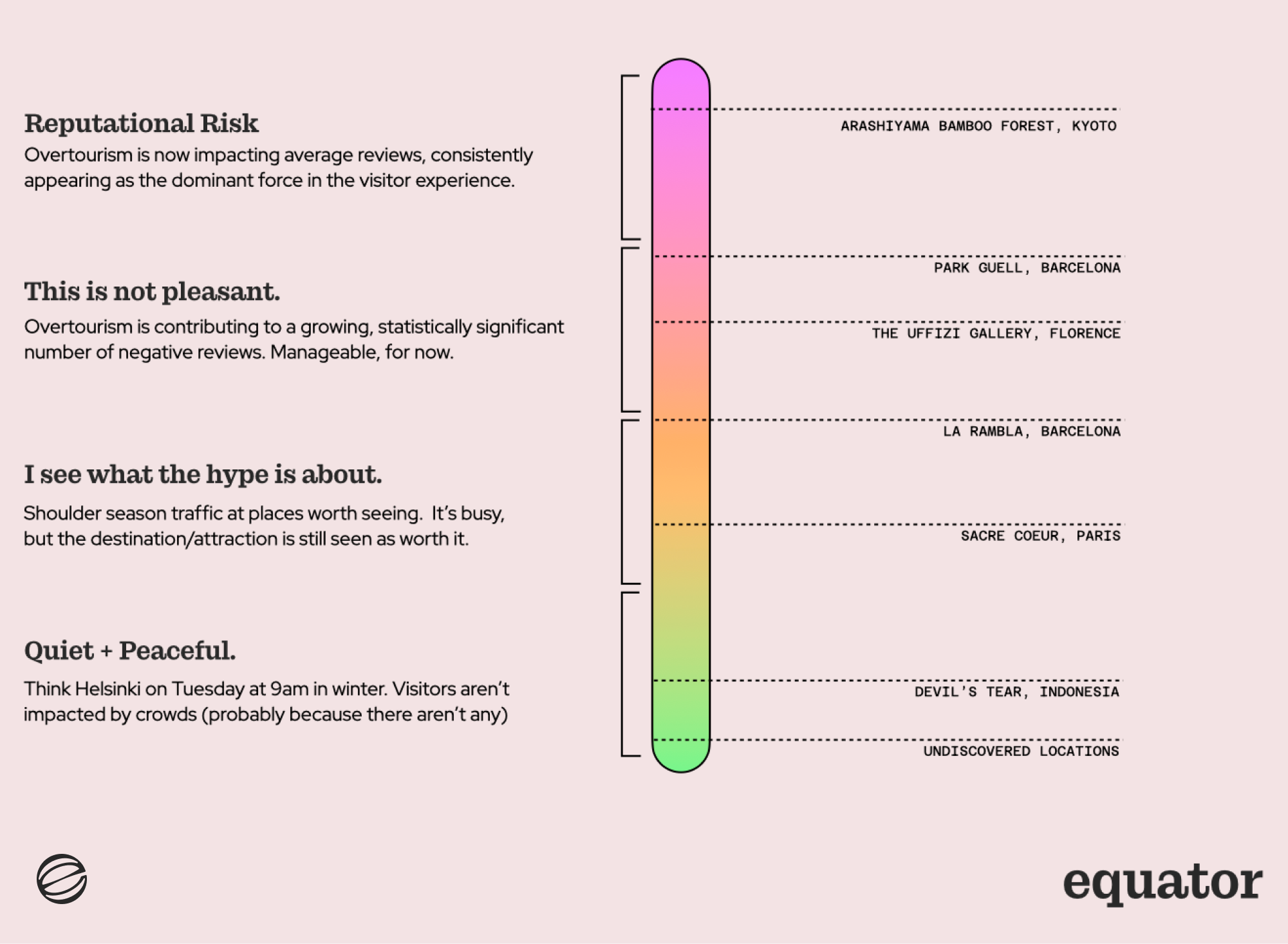
In a sentiment analysis of hundreds of thousands of reviews and posts across global attractions, Equator found that crowds have become the single fastest-growing source of negative visitor feedback. At some of the world’s most iconic sites, the impact is so significant that average ratings are in year-on-year decline.
In Kyoto, Japan, the Arashiyama Bamboo Grove – a site best known for its towering green bamboo stalks – has gone from one of Kyoto’s must-see attractions to “overhyped” and '“not worth the wait”. Of the 10,000 comments and posts analyzed by Equator, one-in-two mentioned crowds, with 15% stating that the crowds were the cause of their negative review (1- or 2-star ratings). In peak season, that number rises to 25%.
It’s a similar story at the Louvre, Paris. Summer visitor ratings at the Louvre have dropped more than a full star — from 4.5 to 3.4 — since 2017. Crowd-related complaints comprise nearly one in five reviews left online at the museum.

To track this at scale, Equator built Crowdshift — a sentiment index that draws on hundreds of thousands of visitor reviews and posts across global attractions. What it reveals is a consistent pattern: the same popularity that makes a destination iconic becomes, past a certain threshold, the very thing that destroys the experience. There’s a reputation ‘decay curve’ to tourism attractions. This decay curve isn’t confined to museums or UNESCO sites – it’s playing out on remote waterfalls in Bali, along hiking trails in Spain, and even at Everest Base Camp.
Tourists begin looking elsewhere
So what happens next? For that, we need only turn to Google Search Trends.
Searches for “best time to visit to avoid crowds” have increased 25x since July of last year. In fact, it doesn’t matter how you phrase ‘avoid tourists’ the same trend shows up. “Authentic travel,” “slow travel,” “off the beaten path,” “hidden gem” - all have increased somewhere between four and forty times compared to previous years.
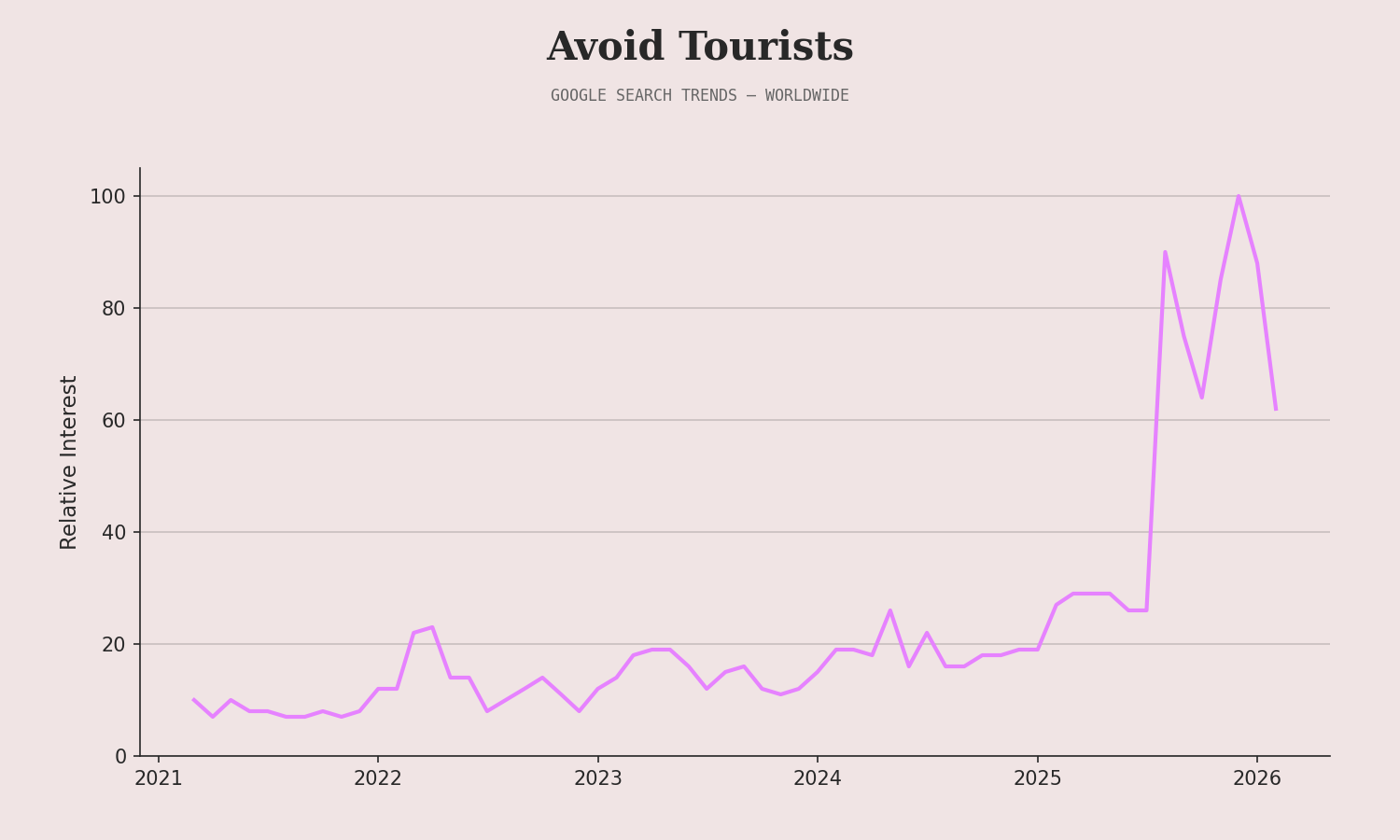
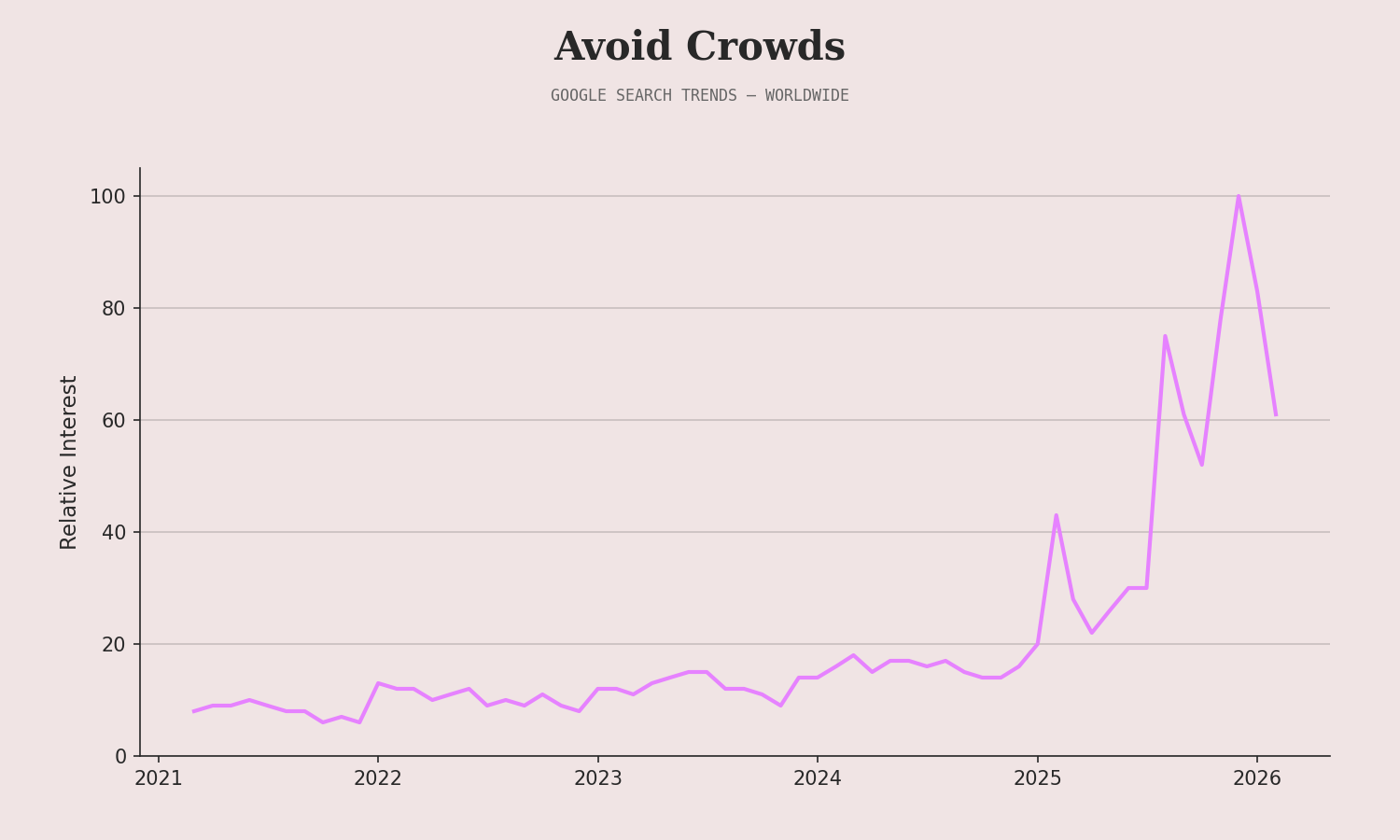
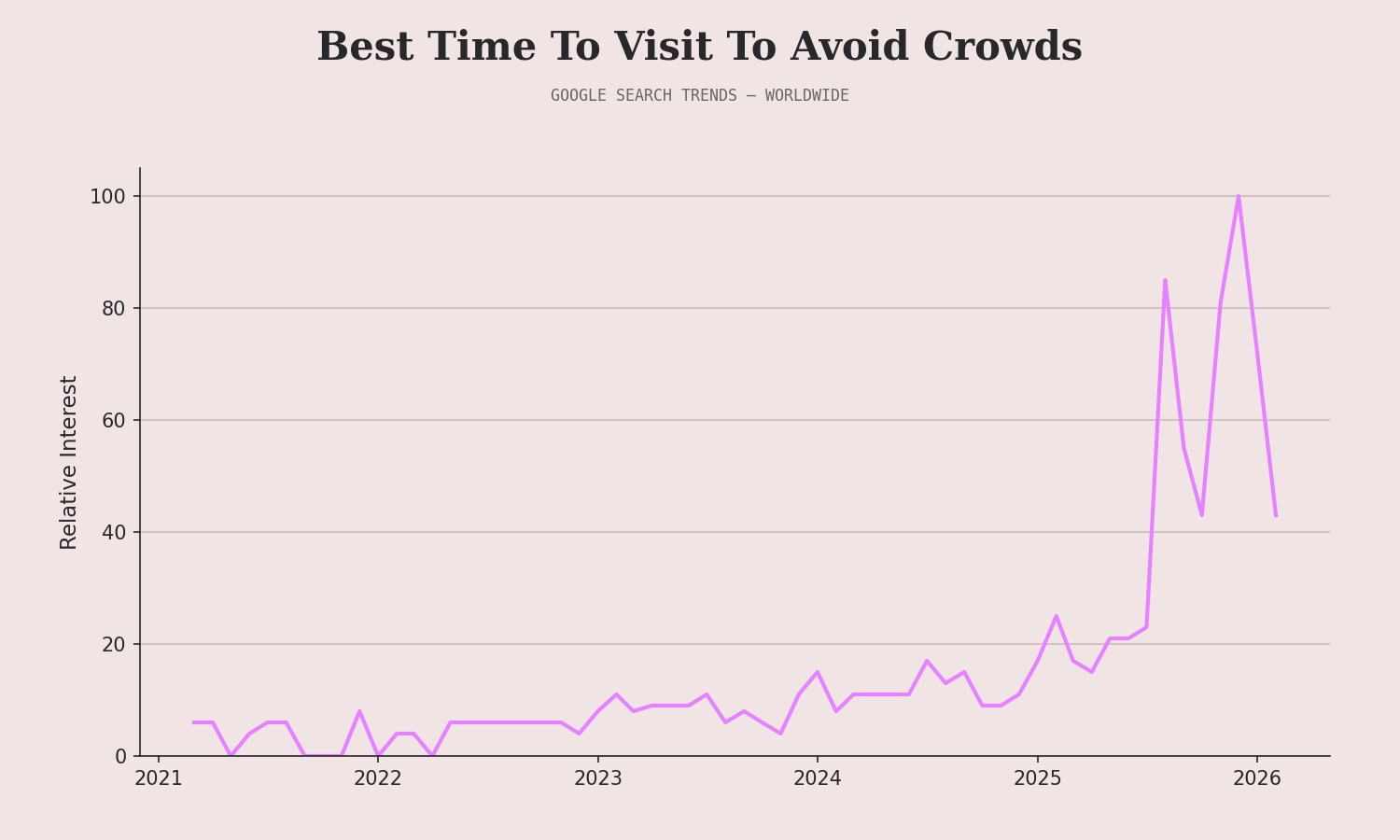
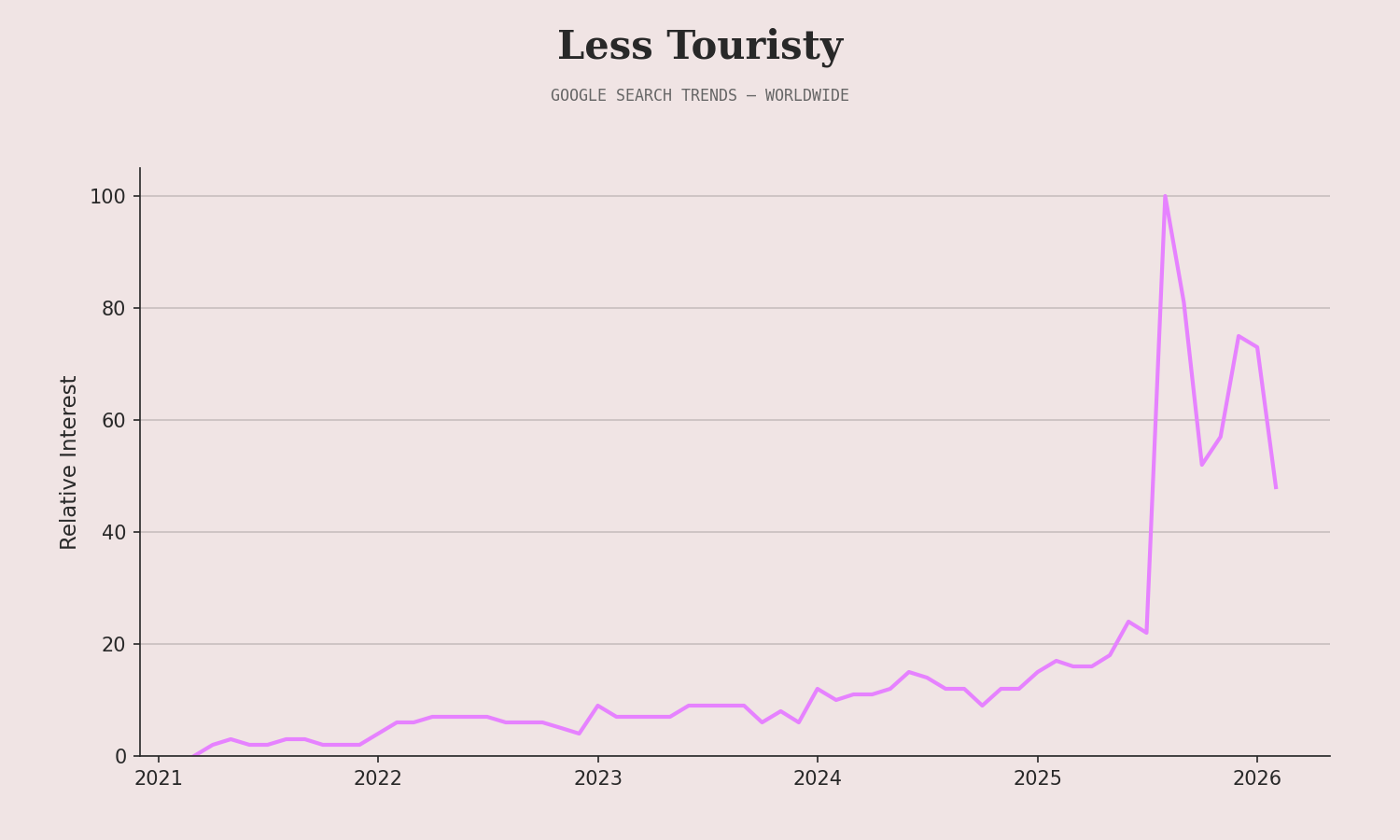
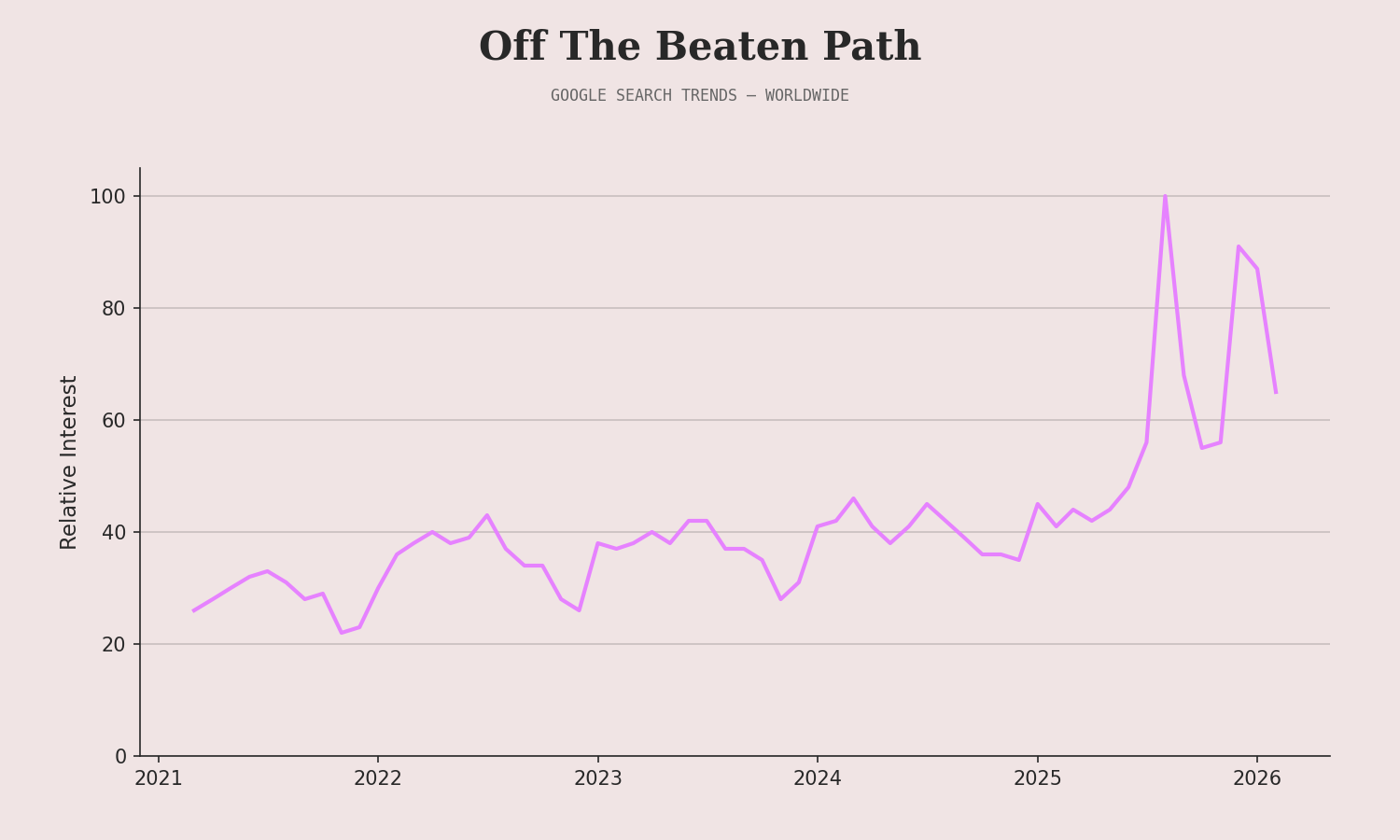
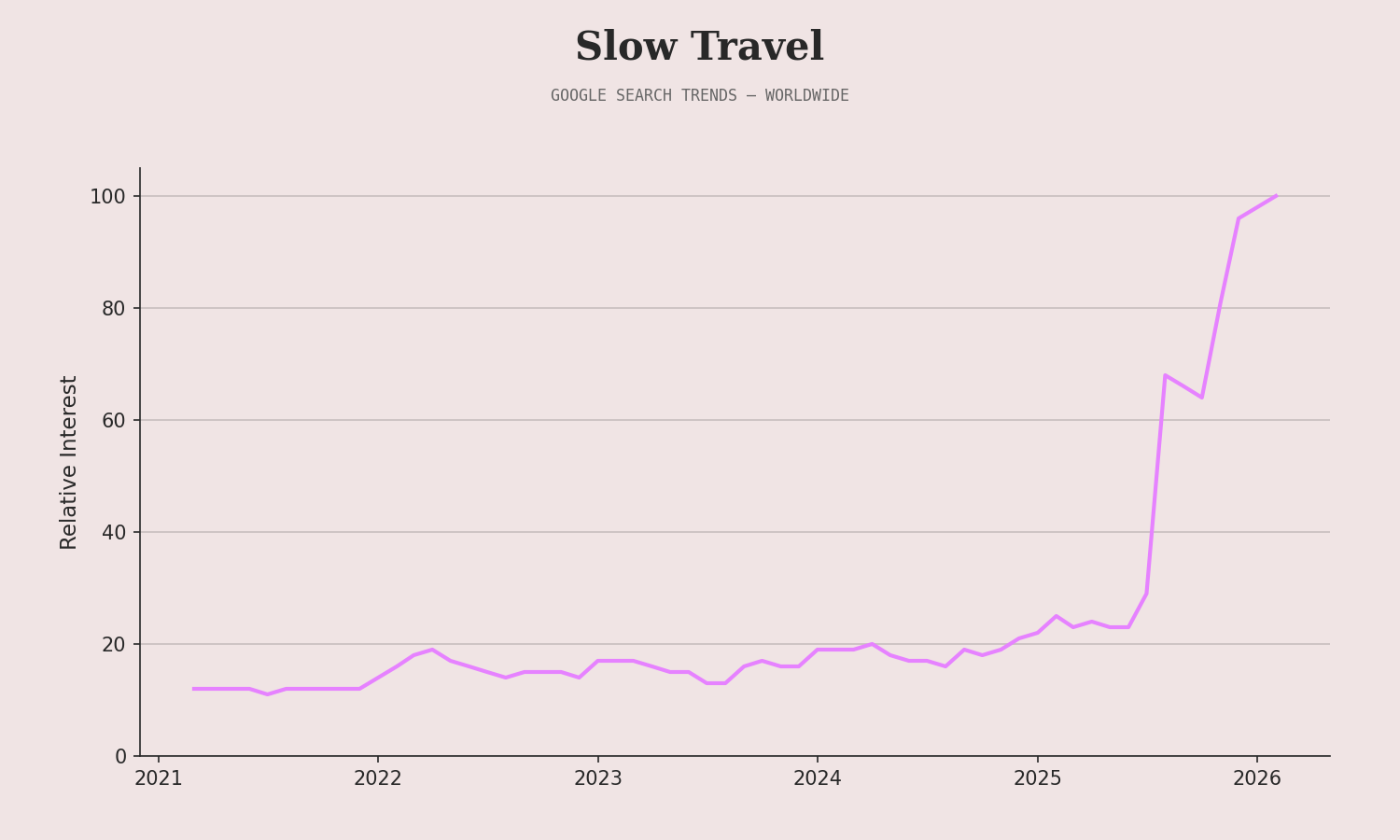
What makes this signal significant is that it isn’t tied to any single viral post or content creator. Nor is it one single event. When six different phrasings of the same underlying question all break sharply upward at the same time, the signal is in the demand, not the supply. In other words, avoiding other tourists is fast becoming a decision-factor in trip planning.
So why are visitor numbers still going up?
If destinations like Venice, the Great Wall of China, and Bali are getting inundated with bad reviews - why are visitor numbers to these destinations still climbing year-on-year?
The simple answer is that these places are not going to become unpopular overnight. We’re not saying that demand is disappearing entirely. The data says that the visitor experience is worsening to the point where avoiding crowds has become a new, and significantly more important of trip planning.

Think of it like this: if you went to a restaurant and the food was great, but the experience was miserable – long waits, a small table located right by the restroom, having to shout over the noise, bad customer service – you’d likely leave a bad review and never return. That’s what is happening to the destination: the “product” hasn’t changed. The experience consuming it has.
So what happens next?
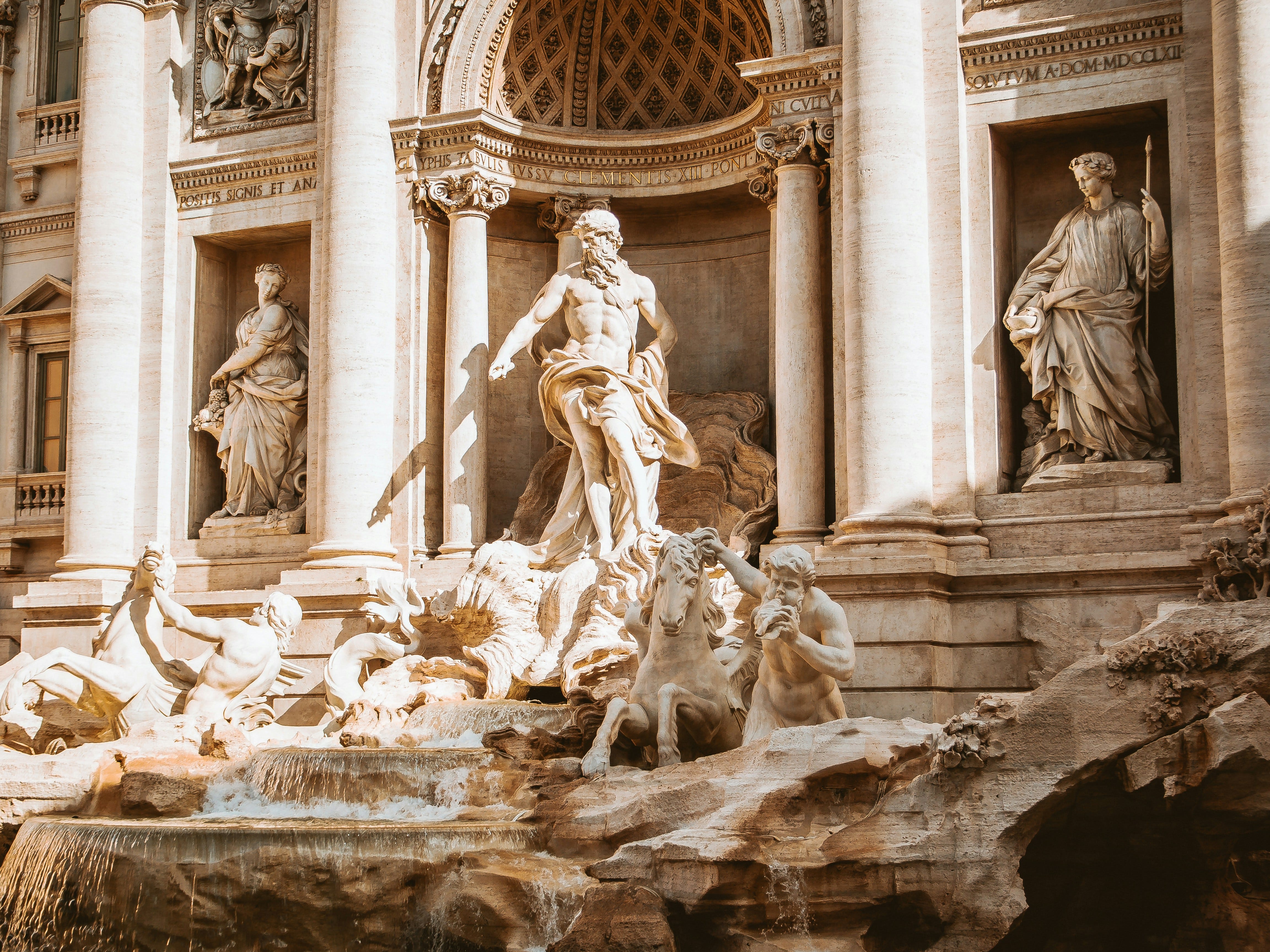
At the destination level, both national and local governments are beginning to respond. Rome has introduced a fee to visit the Trevi Fountain. Barcelona has tightened caps on short-term rentals. Amsterdam have run ‘anti-tourism’ adverts. Bhutan charges tourists a daily fee of $100 simply to enter the country and limits visitor numbers entirely. The Louvre (perhaps the most high-profile example) has announced a structural renovation specifically designed to manage crowd flow and reduce the bottleneck that has turned the Mona Lisa into a five-second photo opportunity flanked by selfie sticks (we made a whole video about this).
The commercial side is, however, wide open.
The question isn’t whether people want to avoid the crowds. The data is fairly clear about that. The question is whether tour operators, travel brands, and the online travel agencies (Booking.com, Viator, Expedia) will move to meet demand – or whether they’ll keep funnelling people to the same overloaded destinations, competing on price for an experience that’s getting worse year-on-year.
In our next article (for paid subscribers), we’ll be laying out what travel businesses can do to stay competitive when crowds are impacting their most popular itineraries - how to identify which destinations in your portfolio are already tipping, where the opportunities are, and how to act on this data now to futureproof your business.
Outlier is brought to you by Equator - an advisory company specialising in tourism data and forecasting traveller trends. We help travel brands anticipate demand and demonstrate impact, so more travellers choose them.
"Crowds become the experience."
The destination doesn’t change. The conditions around it do.
At some point popularity stops adding value and starts eroding it.
Off-season. Bring an umbrella.