
Overtourism doesn't have an off-switch
Why cities can't fight the forces driving crowds to your favourite places

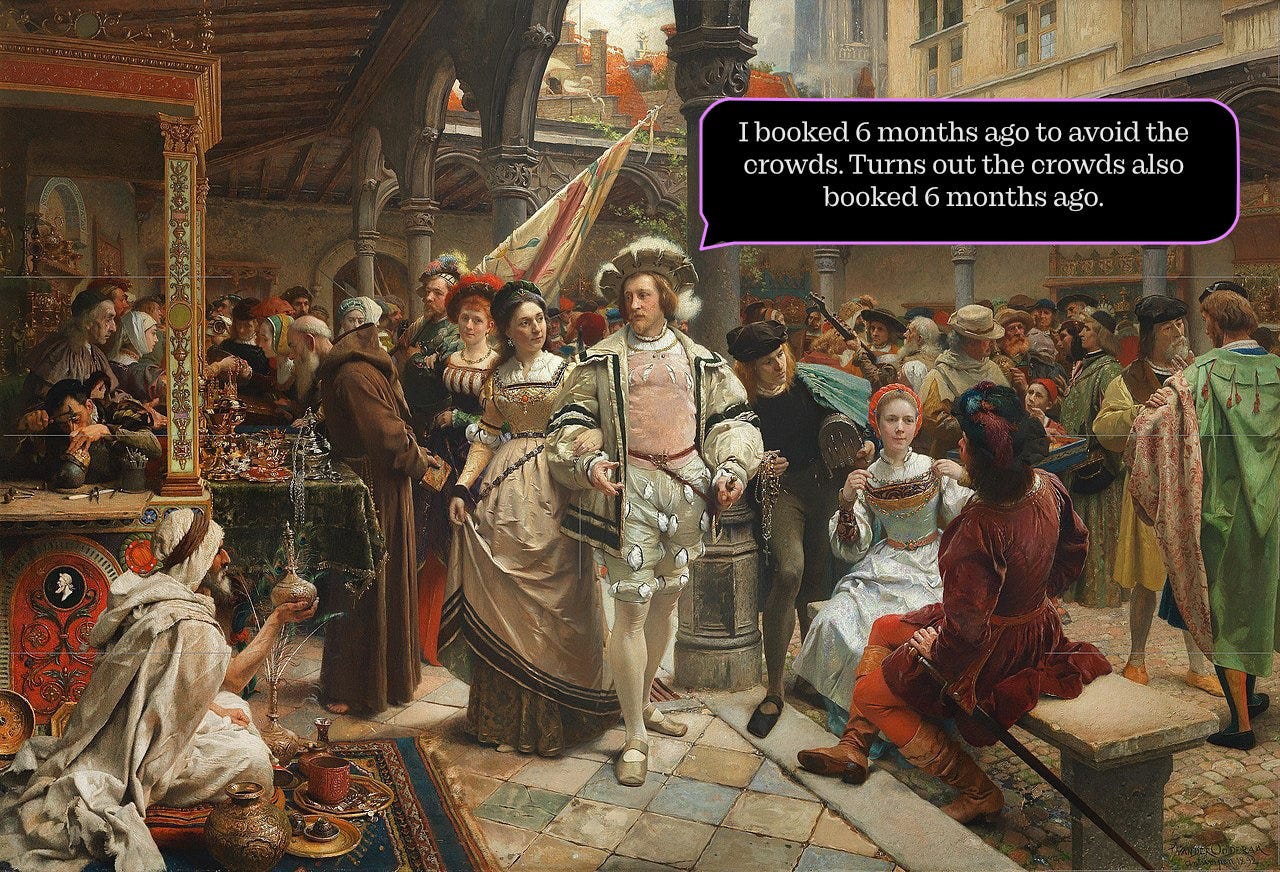
Every few months, a big travel destination announces that it has finally got serious about overtourism. Venice brings in a five-euro day-tripper fee. Barcelona says it will scrap its short-term-let licences by 2028. Amsterdam tells stag parties, in so many words, to stay away. Each announcement is written up as a possible turning point, as if the right blend of taxes, caps and stern multilingual signage might, at last, make tourism ‘go back to normal’.
It won’t. Not because the measures are badly designed (some are rather good) but because they’re missing the point. Overtourism *looks* like a destination problem. It happens in a place, to a place. So we ask the place to fix it.
The problem is that overtourism doesn’t start at the destination. It ends there. A result of global, structural, even behavioural dynamics that have been evolving for decades, exerting pressures on destinations beyond any five euro tax or recently enhanced plan to abate four-hour queues.
In this article, I’m going to explore how three forces have conspired to drive overtourism beyond the control of destinations, and why there is no obvious off-switch that’s going to make the whole thing go away.

Why overtourism has no obvious off-switch
1. The number of people traveling has exploded in the last several decades
Back in 1950, there were about 3 million people who had the means to take a vacation worldwide. That was less than 1% of the world’s population back then. Today, that number is approximately 680 million, or 8% of the world’s population. That is an increase of 223x in just 75 years.
According to UN Tourism, the number of arrivals (a non-resident crossing into a new country) has increased from 25 million global arrivals in 1950, to 1.5 billion today.
This is not a marketing triumph of any particular tourism board. We weren’t suddenly, globally convinced that we – as humans – suddenly needed to travel. It is the expansion of the global middle class: hundreds of millions of people crossing the income threshold at which a passport and a plane ticket become thinkable.

Now, if travellers were evenly distributed across every country and every destination, then this might not be such a problem. But they’re not. In 2019, just ten countries accounted for half of the world’s tourist arrivals. These ten countries are grappling with overtourism at an unprecedented scale.
2. There’s no incentive to do anything about overtourism unless it overtly threatens economic prospects
Travel and tourism is one of the most powerful economic engines a government has access to.
The travel and tourism industry generates around 11 trillion dollars a year and accounts for roughly 1 in 10 jobs worldwide (WTTC, 2024).
Those ten countries that attract around half the world’s tourists are benefiting hugely from it in economic terms. And for many of the least developed nations on earth, it is the single most effective tool they have for alleviating poverty and attracting foreign investment.
Which is why no government on earth is going to throttle it.
Tourism authorities measure success in arrivals, overnight stays, and visitor spend — and they hit those numbers because the numbers are what the treasury rewards them for. Put simply, growth of travel makes too many people, too much money. Unless and until destinations see data proving that overtourism and surging crowds are a threat to their short- or medium-term economic prospects, that isn’t going to change.
3. People are too alike in their travel behaviour
The third driver is perhaps the most stubborn. Where growth is a function of wealth, and incentives a function of policy (both of which could, in principle, change) the behavioural dynamics of how, where and why humans travel are remarkably persistent.
The strength of these dynamics is hard to overstate.
A 2014 MIT study used Bluetooth tracking to map how visitors moved through the Louvre. Visitors who spent more than six hours in the gallery stopped at almost exactly the same set of works as those who spent less than ninety minutes. 500,000 objects in the collection, 35,000 of them on display, and even the most committed art-lovers converged on the same handful: the Mona Lisa, the Venus de Milo, the Winged Victory.

Take FOMO (or Fear of Missing Out). It’s the reason travellers visit the places that are ‘trendy’ even when they suspect those places aren’t worth the visit. A behavioural trait that drives us to the place everyone else is going, not because we think they’re worth the visit, but because we can’t bear the thought of being the person who didn’t. Then there’s social signalling – the phenomenon of getting your partner up at 4am for a perfectly natural photo on a swing in Ubud, just so your social network are alerted to the fact that you too, are #blessed. Travel, in this respect, is a form of social credential and status, where the place matters less than the proof of having been there.
Finally, there’s the ‘Bucket List’. Here the spirit of travel is captured in the form of a checklist, sometimes borrowed from someone else’s catalogue of meaningful places, to be completed before one shuffles off their mortal coil.
It’s not only about where you see your friends going or what you read about in a book when you were younger. There’s a staggering amount of targeted marketing designed to influence your behaviour. Influencers, media campaigns, and sponsorships play a big role in shaping the next travel trend. If you read at least 5-10 travel listicles like the ‘New 7 Wonders’, Tripadvisor’s ‘Top 10’, and TikTok’s ‘5 must-see places in wherever’ in a given year, you will notice a lot of them mention the same places.
This only goes one way…
The pool of people who can afford to travel keeps growing. The destinations chasing them keep growing because the money is too good to refuse. And the travellers keep narrowing in on the same handful of places, because that’s what bucket lists, Instagram, guidebooks, and the deeply human urge to not be the one who missed it all conspire to do.
Consequently, demand for travel is accelerating, paying out, and being amplified by every new attention-seeking content platform. It should be more worrying than it is right now that none of these things has an obvious off-switch.
This begs the question: if the inputs aren’t going to slow down on their own (and they aren’t) what does the next twenty-five years of travel actually look like? And is there anything in the system that might reshape it?
So what happens next?
It’s hard to comprehend just how fast the travel and tourism industry is set to grow.
We’re about to add more to the global travelling population over the next 25 years than we did over the course of the last century (Kharas, Brookings).
So if you’re like me, and don’t love eating at restaurants stacked full of tourists, then I have bad news: it’s going to get a lot busier.
It’s not all bad news though. There are some important shifts happening in travel and tourism. We covered one of these shifts in a previous article. Analysing search trend data, it’s becoming increasingly clear that travellers are increasingly looking for off-the-beaten-path options when planning their trips.

Then there’s the visitor experience itself.
According to CrowdShift – a tool we at Equator built specifically to analyse how crowds impact the visitor experience – crowds are fast becoming a driver of negative reviews at some of the world’s most famous attractions.
Take the Arashiyama Bamboo Grove in Kyoto. Its extraordinary popularity has resulted in 1 in 7 reviews now commenting on crowds, and in high season, 1 in 5 reviews are outright negative. Crowds are becoming the feature at attractions around the world, from the Tegallalang Rice Fields in Bali to the Louvre in Paris. So much so, the French operator Evaneos announced in September 2024 that it would stop selling Mykonos and Santorini holidays for the 2025 summer season — the first time a major European tour operator has voluntarily dropped a flagship destination on the basis of overtourism.
If these trends actually manifest in fundamental changes in discovery, planning and booking patterns, where large groups of travellers forego bucket list attractions and major destinations, then the market will do what regulation hasn’t: force the industry to actually respond.
Until then, I’m going to be a tourist, complaining about all the tourists, and looking for restaurants that don’t have tourists.
Hey, if you’re new here, I’m Edmund. I’ve always loved telling stories with data and exploring dynamics no one talks about. I founded Equator, an advisory firm specialising in tech and big data to surface travel trends and calculate the impact of tourism on communities and destinations.
Overtourism cannot be de-marketed!
Please read this book: "Overtourism" by Professor Rachel Dodds and Professor Richard Butler.
UNESCO World Heritage Sites cannot be enclosed.
There are no tools to mitigate mass tourism. Instead, all destinations resort to establishing paywalls, fees, limits, checkpoints, restrictions and excessive tourist taxes — all of which is not sustainable and they negatively impact the tourism model in the long run.
Fortunately, we have a travel-tech solution to manage the visitor flows inside of the public spaces to reduce the pressures of any touristic hotspot by spreading the economic benefit within the destination and to make the cities and islands livable again.
Support@TouristNewApp.com
Honest question this piece left me with: doesn't the "off the beaten path" trend just move the problem around? The minute enough people go hunting for the quiet alternative, it gets a listicle and a hashtag and becomes the next bamboo grove. I don't have an answer, but I appreciate a writer who admits the five euro fee isn't one either.